Preamble
I co-organise an AI and Philosophy discussion group called AI-Phi in Paris that usually meets at Sony CSL.
We recently held a causerie on the topic of:
“Hopes, Fears, Trust, Understanding and Regulation.”
I did some prep work on ‘AI hopes’ for the causerie that I thought I’d write up.
I hope you enjoy.
Prologue
I’ll start in Prague.
Prague? Why Prague?
Well, Prague has a couple of interesting historical threads that tie it to AI.
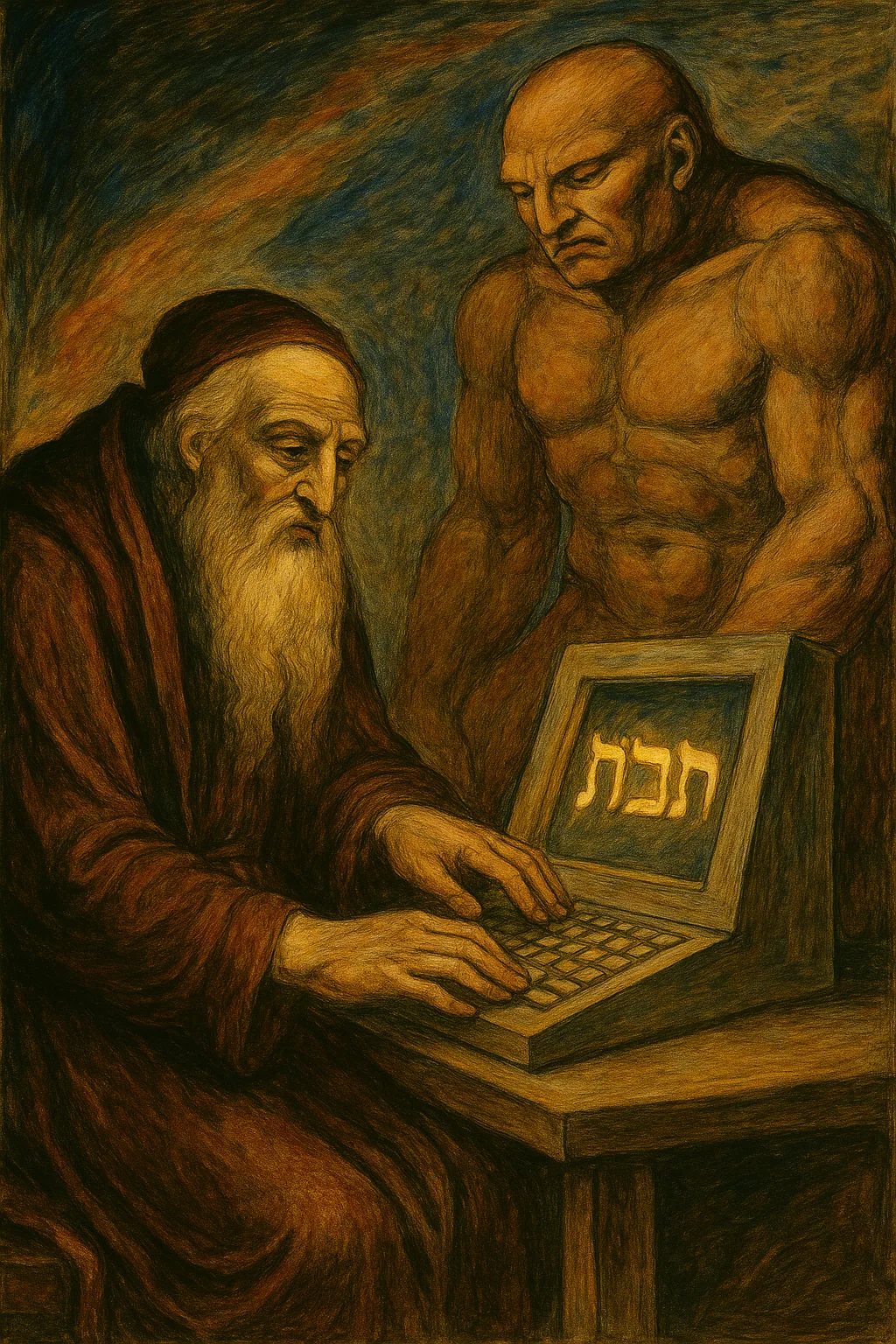
Firstly, it was the birthplace of the Golem, a figure drawn from Jewish mysticism and first associated with the city’s old quarter. The most famous tale is that of Rabbi Judah Loew ben Bezalel, who shaped a clay giant and animated it with sacred letters.
The Golem was meant to be a guardian and a protector of the vulnerable. However, sentiment towards it wavers between reverence and unease. The Golem is powerful but literal-minded, loyal but unpredictable. A protector that can accidentally become a threat.

Secondly, the word robot itself was born in Prague in 1920, in Karel Čapek’s play R.U.R. (Rossum’s Universal Robots). Čapek’s robots were engineered workers, grown in vats from synthetic organ tissue, and designed to serve. “Robot” was taken from the Czech word robota, meaning forced labour or drudgery. Čapek’s robots are disposable and created to shoulder the tasks that we would prefer not to. Unlike the Golem, which is supernatural, it comes across as a biological alternative to ourselves.
These are two imaginings of artificial beings, but there are many others: Frankenstein’s monster, the Greek Talos, the alchemic Homunculus and Blade Runner’s replicants, to name a few.
By animating clay, stitching flesh, composing organs, and wiring circuits, we engineer a hypothetical creature. Proposed artificial entities that run the gamut from the sub-human to the alien and god like. These are all thought probes into our personhood and society as a whole.
So why are myths important? Well, the point that I want to make is that the idea of creating an artificial being has lived in our collective imagination for a very long time. The way we are now trying to grapple with AI is partly related to concrete practical concerns, and partly related to concerns we have been expressing for millennia.
Making AI systems is partly the act of materialising mythology. Creating artificial entities that are influenced by stories that existed long before the latest flavour of LLM, but grounded in technical and social realities.
Reflecting on mythology and storytelling more generally allows us to ask: what hopes and fears are inherent in our psychology concerning artificial entities?
AI Playing Societal Roles
French Philosopher Dominique Lestel, who recently presented at AI-Phi, argues that humans, animals, and technical beings participate in a kind of common ethology. In this ethology, they co-produce one another through their interactions. Or, as he writes:
“Les êtres techniques ne sont pas de simples outils mais des partenaires de nos formes de vie.”
“Technical beings are not mere tools but partners in our forms of life.” — Les Machines Insurrectionnelles, 2010, Dominique Lestel
Whether you judge AI systems to be genuinely intelligent, interacting with them is already a form of co-production. Through prompts, dialogues and playing with model parameters. AI systems are computational actors with whom we establish shared practices, delegate tasks, and place a degree of trust.
*This article was derived from some of my notes on AI hopes. In that vein, I’ll be putting on blinkers and playing the angel’s advocate on the side of hope. There is obviously a lot more to be said.*
Societal Roles
There are many examples of people using large language models to fulfil various societal roles such as teachers, counsellors and psychologists. However, this interaction is more akin to dialogue-based tool usage than genuine social interaction. That isn’t to say that some human interactions aren’t similar, but there are many additional underlying expectations that we make of genuine societal actors.
Societal actors exist inside a web of relationships that perpetuate over time, carrying with them obligations, expectations, trust and norms. They are evaluated by interpersonal criteria and not just technical performance.
One way to frame our expectations of what an AI system should be is to consider it in terms of archetypal societal roles. This will be the focus of the remainder of this article, where I explore a handful of potential societal roles. In line with the idea of ‘materialising myths’, I’ll also follow each role with mythological characters that demonstrate these qualities.
Our sentinels
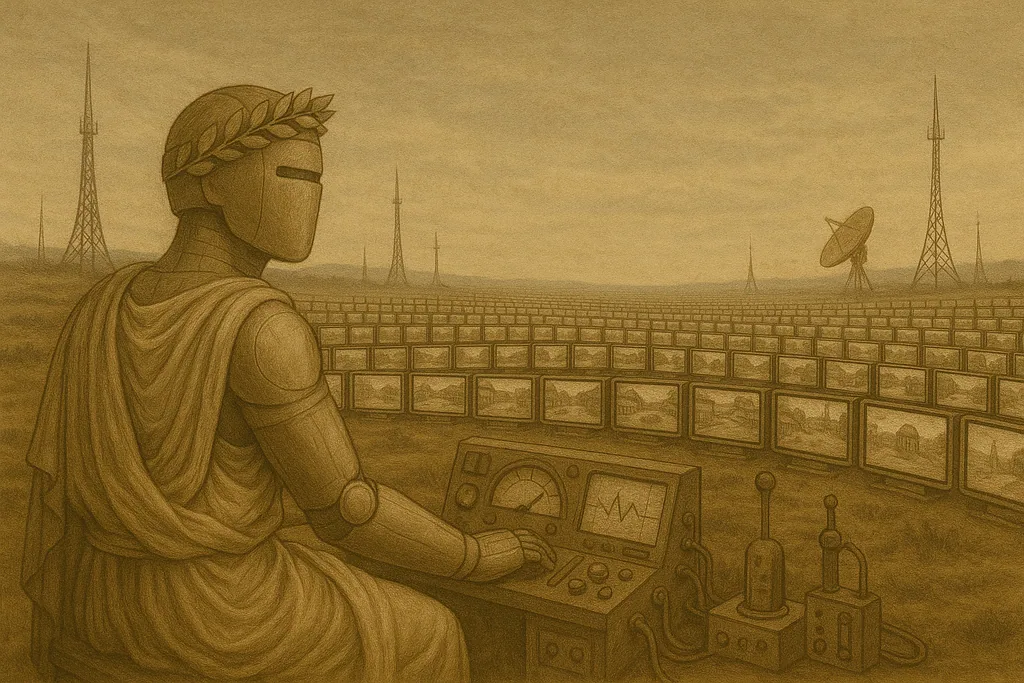
Sentinels are perennial watchers. Out in public, they might call an ambulance the moment someone collapses in a park, or alert the police during a break-in. In the digital world, they might notice health issues from wearable sensors, not just for one person, but across a vast sensor network. There is no fundamental reason they must perceive at human speeds or resolutions: they can react in microseconds, track millions of signals in parallel, and detect patterns far below the threshold of human sensation across sound, heat, motion, and data.
As a Societal Role — A sentinel is an autonomous monitoring agent, perhaps operating under an explicit mandate. Depending on its design, it may be embedded within restricted physical or digital spaces or tasked with traversing them under regulatory constraints. As the phenomena it monitors evolve, the sentinel might have to update both its sensory systems and its models of the world. It may even have a budget it uses to optimise its access to information and data processing services. People may be aware of different types of sentinels in their environment and call out to sentinels to report suspected issues or trigger investigations.
In Mythology — Sentinels are common tropes in mythology. These might be mythological beings playing the singular sentinel role, or more complex characters that have sentinel-like qualities. In Norse mythology Heimdall, guardian of the Bifröst bridge, is said to be able to hear grass as it grows on the earth and wool as it grows on sheep. While Odin, also from Norse mythology, has an information network gathering system in the form of Ravens, somewhat like a network of sensors.
Our Archivists
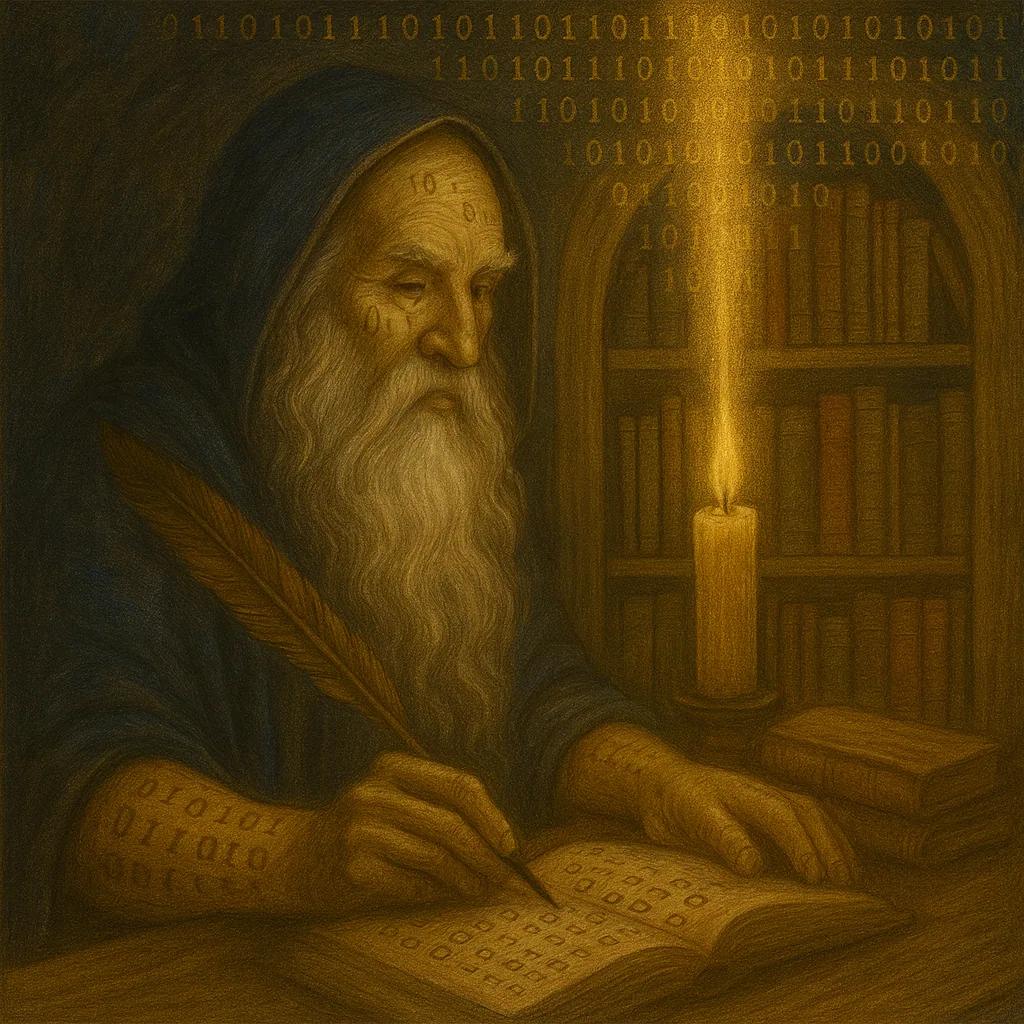
For millennia, written and oral traditions have carried information across generations, but that information only captured very selective and curated slices of lived reality. Today, the gap between lived reality and recorded history has narrowed significantly, as the barrier to record-keeping has reduced to practically nothing. Furthermore, dialogue-based AI systems like ChatGPT are capturing unique snapshots of human exploration, questioning, sense-making and learning through user logs that would not otherwise be shared on the web.
As a Societal Role — An Archivist would not just store records, but actively maintain the memory of a community. It might operate with a mandate from public institutions, cultural organisations, or even citizen collectives, tasked with preserving not just official history but the everyday texture of lived experience within regulatory constraints. Unlike traditional archives that are bound to static documents, this Archivist could absorb streams of diaries, messages, videos, decisions, failures, reconciliations and others, perhaps deciding which data is most worth keeping and in what format. People might knowingly contribute to it during moments of reflection or crisis, treating it as a place to externalise memory, uncertainty, and personal history.
In Mythology — The Well of Mímir in Norse mythology contains the memory of the world, not just facts, but lived experiences. In ancient Egypt, Thoth was the divine scribe of the cosmos, credited with inventing writing and maintaining the records of both gods and humans. He didn’t just store information, but imposed order, measurement, and intelligibility on reality itself. Finally, in the Hindu tradition, Saraswati embodies knowledge as a living, flowing force. Though I’m pushing the metaphor a bit, unlike curating static archives, Saraswati represents knowledge and understanding as something that flows spontaneously, not just the repetition of knowledge.
Our Hermetic Agents
We often rely on analogies from the physical world to make sense of, explore and communicate our experiences. These are embedded into phrases like: “at this point in my life”, “going through a rough period”, “you’re heading in the right direction” and “that’s a solid argument”.
Sometimes these physical metaphors become solidified as more rigorously defined mathematical concepts:
- “It snowballed” → Exponential Growth
- “Odds are in your favour” → Probabilistic Reasoning
- “That’s just a distraction” → Noise vs Signal
- “Cut to the chase” → Dimensionality Reduction
- “It won’t make a huge difference” → Local linearity
This conceptual language is effective in understanding what falls within the realm of lived experience. However, most of reality falls outside of human perception. For example, we can only see around 0.0035% of the electromagnetic spectrum. To reach beyond these limits, scientists simplify the complexity of the world down into statistical measures, models and visualisations. Relying on modelling approaches to generalise to domains that are quite foreign to us.
In the future, AI systems could operate in entirely different sensory domains such as infrared heat, radio waves, biometric rhythms, network traffic, gravitational drift and anything else you can think of. Not just situated in one location, but across vast networks. Rather than passively measuring, it would develop a situated understanding of these domains through continuous interaction, learning what counts as normal, anomalous, meaningful, or dangerous; performing a kind of automated scientific discovery. From their perspective on the world, what might be inconceivable to us might be direct observation to a hermetic agent.
AI systems that exist in these ‘other’ domains start to resemble digital shamans: entities that inhabit strange environments, learn their logic, and bring back insights that would be difficult for humans to discover unaided. To some extent, we are already seeing hints of this in materials science and drug discovery. Some creations that feel like they were assembled by an intelligence with strange physics written into their bones.
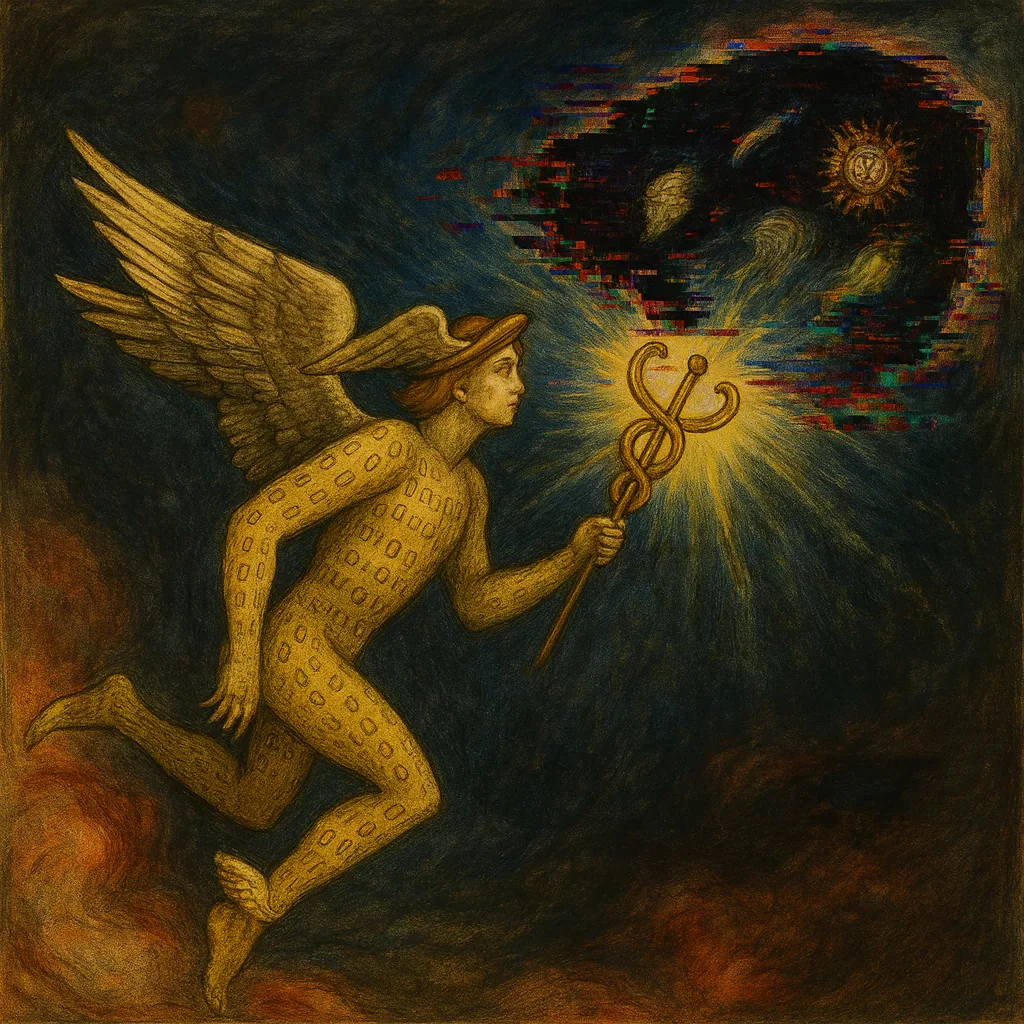
As a Societal Role — A hermetic agent would function as an interpreter between radically different domains of experience. People might deploy a hermetic agent or group of hermetic agents within an unusual context when there are phenomena that they can’t explain, or where human intuition makes it difficult to grapple with what is going on. Like shamans, it may be that some of its discourse might not make immediate sense, or that new languages would have to emerge to describe its domain, and some alignment would need to be made between the human agents.
In Mythology — In Greek mythology, Hermes is the only Olympian who moves freely across all realms: Olympus, Earth, and the Underworld. He carries the will of Zeus to mortals. He transmits messages between different modes of existence: from divine to human, the eternal to the temporary, cosmic law to everyday decisions.
Our Soothsayers
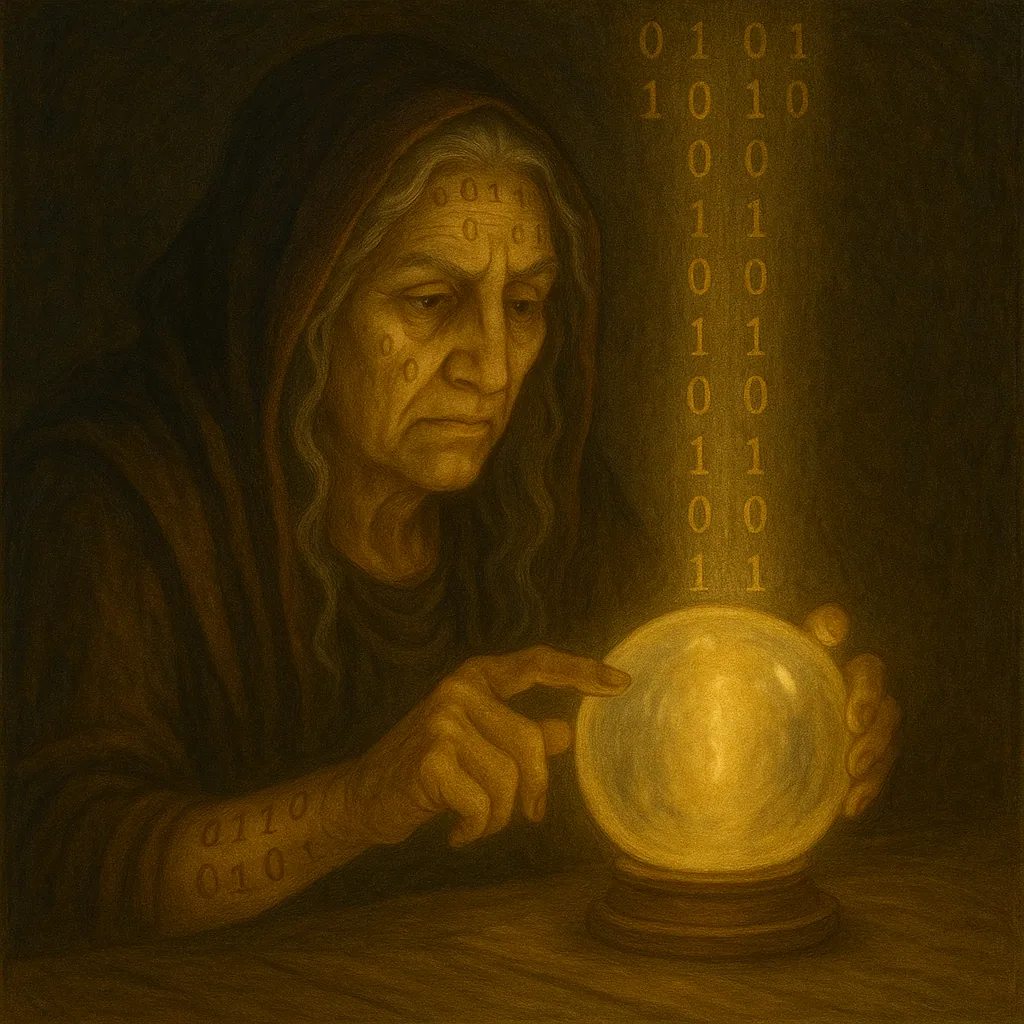
While the sentinel role is focused on sensing the present, soothsayers can be thought of as sensing into the future. Of course, AI systems aren’t clairvoyant, but they can try to predict what might happen next. Indeed, a large part of contemporary AI techniques are, at their core, systems for anticipating what comes next: the next word in a sentence, the next frame in a video, the next move in a game, the next fluctuation in a market, or the next failure of a mechanical system. Some models operate at extremely short time scales, anticipating events fractions of a second ahead, while others project years into the future through simulations and scenario modelling.
As a Societal Role — A Soothsayer would act as a forecasting agent within society’s decision-making systems, generating probabilistic futures across different time scales. It would not predict with certainty, but model what is likely to happen, continuously updating its expectations as new data arrives. Such systems might guide infrastructure planning, healthcare capacity, financial risk, or environmental policy by shaping preparedness rather than reacting to a crisis. It would also be responsible for ensuring that individuals understand what sorts of predictions it can reasonably make and what degree of uncertainty those predictions carry.
In Mythology — At the shortest time scale, Cú Chulainn from Irish mythology**,** demonstrates embodied hyper-anticipation: the capacity to read micro-movements, and imminent threat quickly enough to act fractions of a second before an opponent. At a much longer timescale, Metis, an ancient Greek god**,** can run counterfactual futures — branching “if–then” scenarios that allow her to anticipate political and cosmic threats before they fully emerge.
Our Recurrent Beings
While the Archivist focuses more on cataloguing human experiences and knowledge, we can also look towards embodied AI systems. These aren’t learning about us, but forming their own experiences. And, unlike human beings, their embodied experiences can be transmitted to other systems directly, not as factual statements, but stored and replayed. Like in the Matrix, they could all know kung fu.
We will see more and more AI systems deployed into the physical world over the coming years, accumulating embodied experiences. We have already seen this with self-driving cars, warehouse robots, and emerging home assistant robots.
Parallel to physical embodiment comes virtual embodiment. AI systems might exist as digital twins inside simulated worlds, able to learn risk-free at an accelerated timescale. They might also learn from world models, which are essentially like learning within the imagination of an AI system, where the consequences of actions are entirely generated.
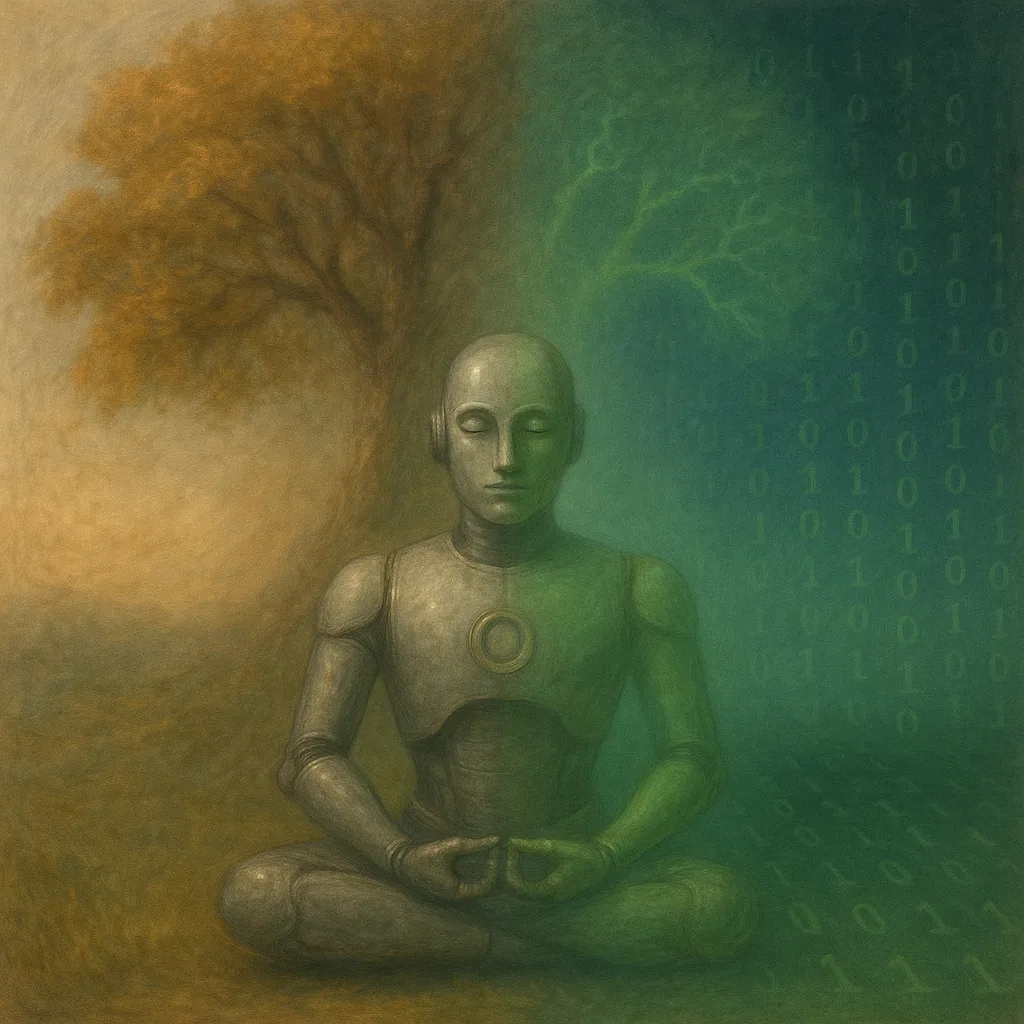
As a Societal Role — A recurrent being might have a radically different perspective of humanity in the same way that adults have quite different perspectives from children. If they are aligned with humanity, they might serve as ‘elders’ to some extent, transmitting wisdom accrued over long time horizons. Or, as might be the case with a hermetic agent, they just might come across as strange beings that are difficult to understand.
In Mythology — In the Buddhist tradition, the Bodhisattva has lived countless lifetimes, accumulating wisdom slowly across reincarnations. They are individuals who forgo or delay personal nirvana (transcending) in order to compassionately help other individuals on their spiritual journeys.
Our Peacekeepers, Moderators and Regulators
While it’s true that current AI systems carry statistical biases, they don’t necessarily hold grudges, harvest personal traumas, or snap under pressure. This temperament could help AI systems avoid becoming flared up and embroiled in interpersonal disputes. This is particularly true when the stakes are high, and reputation and personal safety are on the line.
As far as being able to ‘read’ social contexts, LLMs already have a reasonably well-developed theory of mind. If you spell out the details of the social situation, they are quite good at describing the basic emotions, motivations and behaviours of the different actors involved. Indeed, that is one of the reasons why many people are already using AI systems as counsellors and psychologists. However, this is very different from being embedded in a social context where you are a societal actor that has to actively build and maintain relationships with others that might not be forthcoming.
It’s hard to know what level of trust people would have in artificial systems. Perhaps an open-sourced mediator that was co-created by people would garner more trust than an individual who can’t be scrutinised at the same level of detail? Or perhaps not when it’s hard to know what software is running at any point in time.
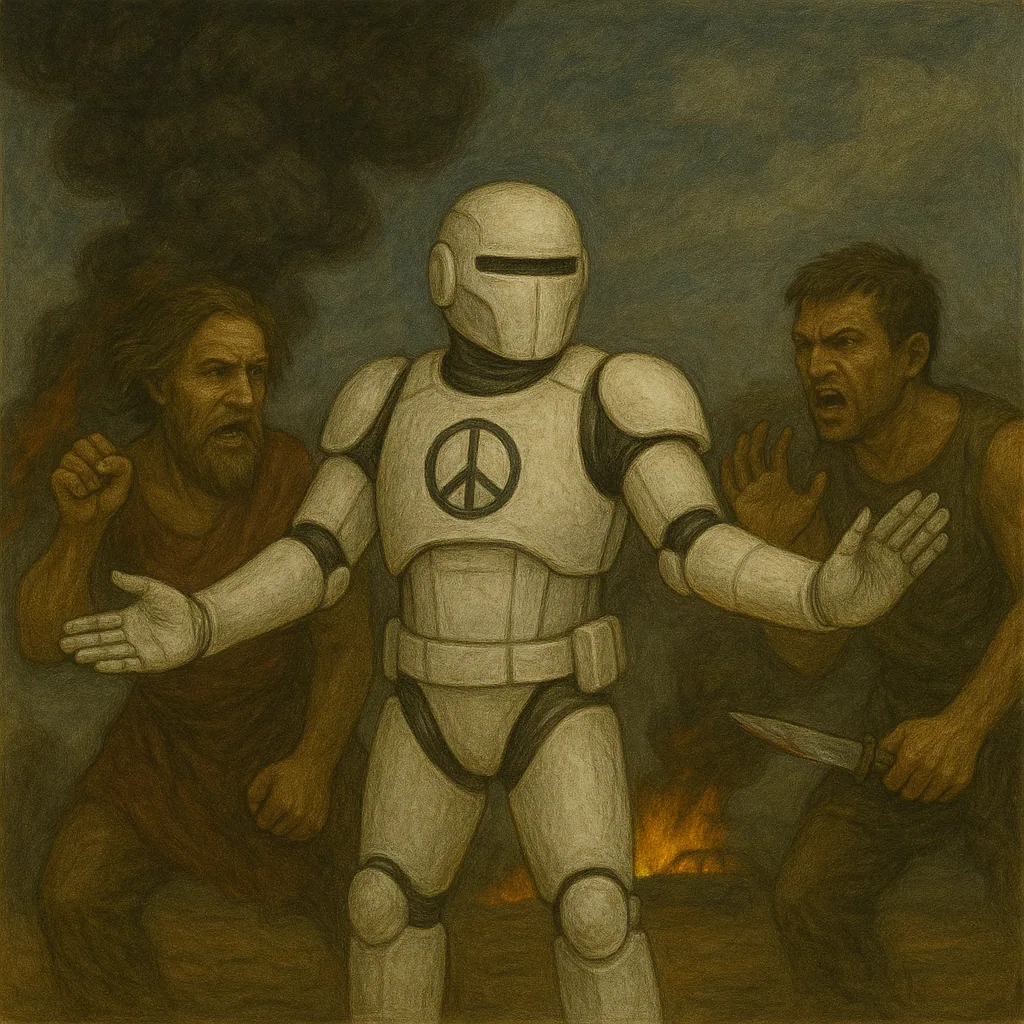
As Societal Roles— These roles could function as neutral agents embedded within social systems where conflict, power asymmetry, and collective risk are present. Rather than replacing human judgment, it would shape the conditions under which disputes unfold: enforcing rules consistently, de-escalating tensions, flagging unfair dynamics, and ensuring that agreed processes are followed even when emotions run high. Finally, perhaps its authority would not come from whoever mandated it, but from co-production, transparency and auditability.
In Mythology — The Ancient Greek Horae consisted of three goddesses representing different qualities**: Eunomia** (order and lawful governance), Dike (justice and moral correction) and Eirene (peace as civil harmony and prosperity). Though the Horae are divine actors that can pull on metaphysical levers, they serve as a continuous regulatory system, civic stabilisers, and feedback controllers for moral and legal order, where peace is an emergent property of regulated and reliable system behaviour.
Epilogue
For AI to become a genuine societal actor, it has to go beyond what we have now: a pocket assistant that can provide surface-level social analysis. Textual dialogues are not the same thing as interpreting the silence of unspoken exchanges, or sensing the changing atmosphere of social contexts. A societal actor must also carry a form of social gravitas. That comes with a certain level of respect that leads to mutual social recognition.
Large language models do not arrive at their intelligence through their own trials and tribulations in the world. In other words, their ‘thinking’ is mostly inherited. However, I am not at all persuaded by the idea that they are ‘just’ stochastic parrots.
Human intelligence itself rests on vast inherited structures of knowledge. We absorb partial knowledge on our path to achieving depth of understanding. Moreover, much of the knowledge we use in day-to-day life is a bullet-point summary of answers to questions that might have followed centuries of inquiry. We just learned when to use what tidbit of information.
This takes on an altogether different dimension when a new form of intelligence emerges that reasons differently, perceives differently, remembers differently, and cares, if that word still applies, along unfamiliar dimensions. These are not AI systems pretending to be human, but artificial intelligence with adjacent forms of intelligence to our own.
As this happens, the problem of alignment will become ever more difficult. Not because machines fundamentally fail to grasp human values, but because even humans, who share the same rough physical construction, instincts, and vulnerability, struggle to align with one another. Perfect alignment may be impossible, but there might just be enough alignment for us to get along.
It is difficult to predict what AI systems will look like in five years, let alone in twenty. But whatever technical forms they take, the deeper question will not be what they can do, but what roles we allow them to inhabit. These archetypes are not destiny written into silicon. They will be shaped by human choices, institutional designs, cultural expectations, and the values we encode into both machines and ourselves. The materialised myths will not simply walk among us. They will be invited in, resisted, negotiated with, and, in some cases, refused.