This is Part II of the Light and Dark of Awe. You can find Part I here.
Recap
“Part I — Awe-some” explored the light side of awe: the uplifting, expansive experience that comes from encountering something vast. Whether sparked by something in our environment or society, this form of awe tends to dissolve boundaries, deepen our sense of connection, and shift our values toward greater compassion and altruism.
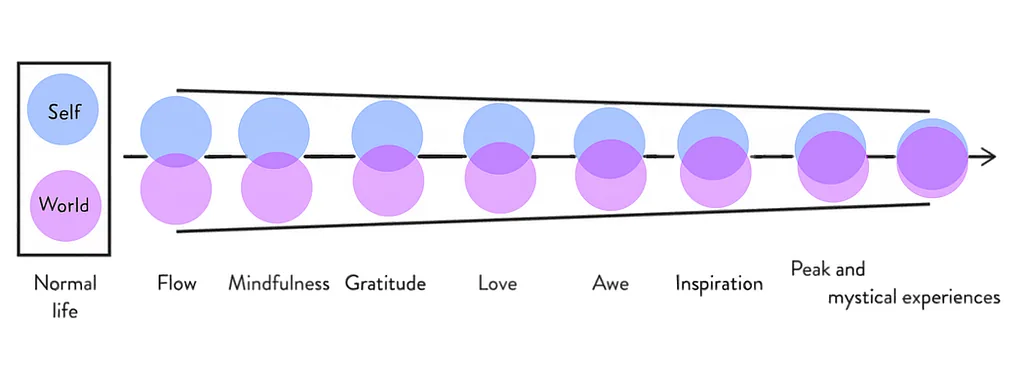
That brought me to the unitary continuum¹. This simple model tries to map out various states including ‘awe’ in terms of the degree of overlap between the self and the world. This overlap corresponds to states that range from flow states (some overlap) to the mystical states (strong overlap). I started to venture away from awe and began to question what the range of possible states might be.

I argued that seemingly mundane aspects of everyday life also involve simple forms of self-transcendence that we take for granted. The morning light spilling through the window, the warmth of tea in hand, the rhythm of your walk to the metro station, familiar faces and shop fronts glancing past. These all form a kind of warm reassurance that life is in order and you belong; subtle threads that tie us to the world.
In Part II…
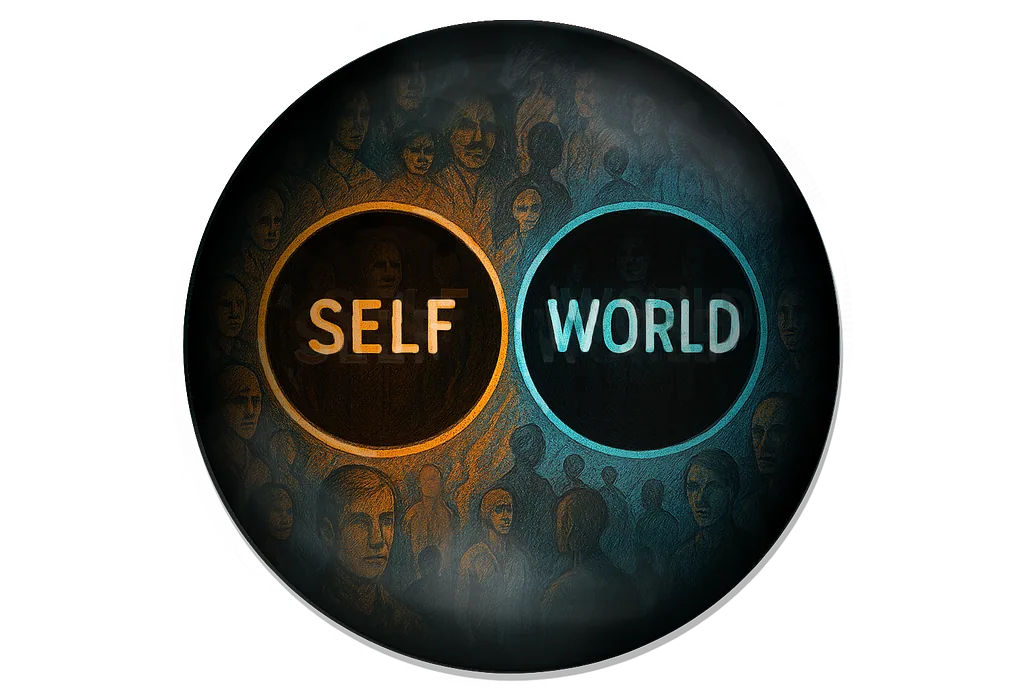
…we will look at the point where the overlap between the self and the world moves towards disjunction, where we start to disconnect from the world.
I’ll argue that this is where we encounter the ‘aw-ful’ sense of the word awe. Here, the word ‘awful’ still carries a leftover sense of ‘awe’ that was common until the 1800s.
Awe as something threatening and terrifying.
Buckle up.
Disclaimer: I’ll be touching on concepts related to mental health in this post. I’m not a clinician, nor do I have a background in psychology. Instead, this post serves as an outlet for my broad interests and reflections on people and society, as well as a concrete artefact as the basis for future thought and collaboration.
The Small Self and The Withered Self
The small self hypothesis¹ suggests that people feel their sense of self shrink during experiences of awe. It’s the feeling of becoming smaller against something vast. This is the positive form of awe from Part I that I’ll refer to as wonder-awe.
The terrifying form of awe is referred to as threat-awe¹⁰, and though it is usually evoked by environmental experiences such as extreme weather events (like hurricanes), it has also been explored in the context of individuals.
While somebody like Nelson Mandela might inspire people to make large-scale changes through wonder-awe, somebody like Hitler might inspire people to devastating change through threat-awe¹¹.
There’s another kind of “feeling small” that might have passed through your mind when the world feels overwhelmingly large, and you are too weak to meet it. Instead of being dissolved in wonder, you are stripped of agency and made to feel inadequate. This fosters shame, withdrawal and defensiveness.
So, what might be going on here?
Going back to Bai et al 2017 ² from Part I, there are a few experimental observations about wonder-awe that offer some clues:
Awe did not diminish one’s sense of status or rank (Studies 3–5) … nor did it diminish individuals’ self-esteem … [it did not] diminish perceptions of humans in general … did not diminish perceptions of the size of other people in one’s social network
This seems to imply a shift in how you frame yourself. It’s a altered scale — zooming out to encompass a larger perspective. From that distance, the noise and hustle and bustle of life and interpersonal relationships disappear, and humanity becomes a unified blob against the cosmos. You see yourself from that distant perspective, and for some reason, that often comes with a greater feeling of interconnectedness.
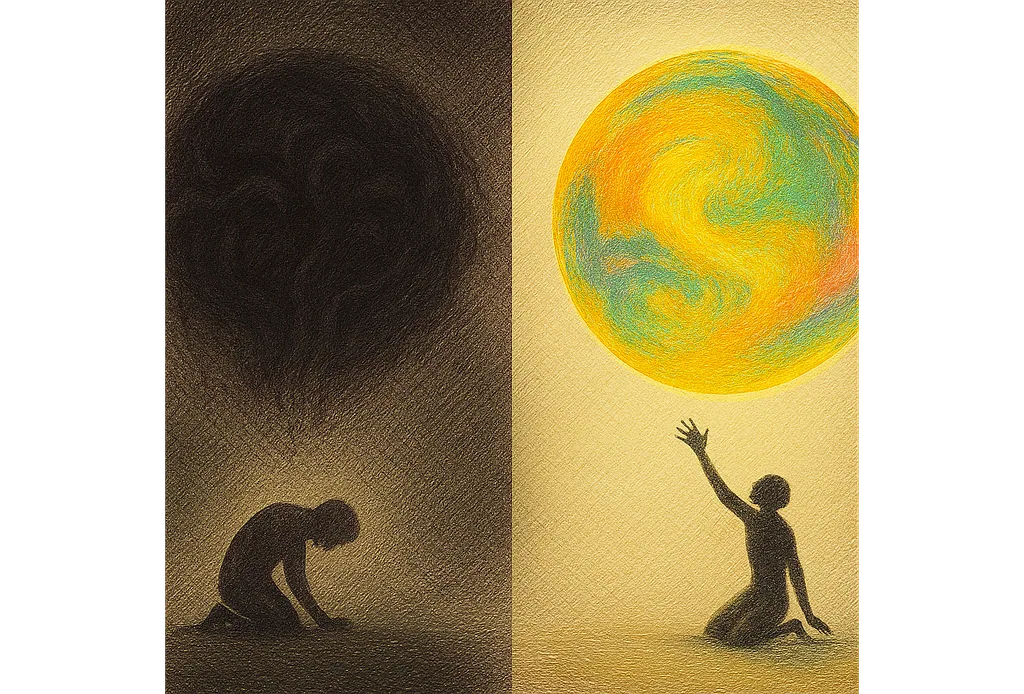
The experience of the withered self isn’t that kind of operation. Instead, it’s you folding into your self as your thoughts become more and more self-referential. The default mode network (DMN) dominates (we discussed this in Part I), and the mind folds in on itself, endlessly self-narrating. This hyper-self leads to the feeling that everything happens to you. In that context, humanity looms overhead and externalities become potential aggressors and judges. You are alone in an isolated and brutal context.
Suffering
It’s worth tying together our observation that the withered self might be a threat-awe response back to the unitary continuum.
Susan Chen in “Awe and the Interconnected Self”³ suggests that depression can be viewed as the opposite experience to awe. She writes:
Depression comes with a loss of connection, and an exaggerated impression of separateness from the world. It is dominated by negative self-referential thoughts and attention biases that reinforce the loop between negative emotions and thoughts. This depressive bias is reflected and established in neural circuits within the DMN that make it difficult to integrate and accommodate informationrich stimuli lying outside the self.³
Depression here is not the definitive opposite of ‘awe’ so much as one of a collection of possible states where self-world relationships are dysregulated. I would argue that the withered self approximately belongs here as well.
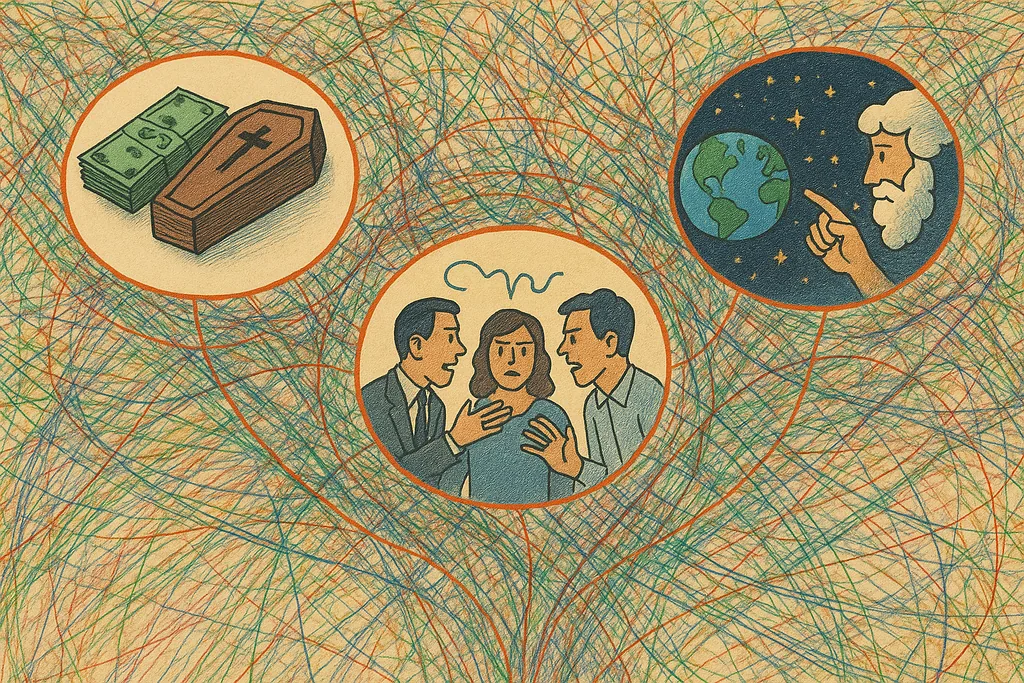
Susan Chen³ mentions the default mode network (DMN). I imagine this has a lot to do with our self-world overlap. There is a spectrum of functional consequences⁴ of DMN problems, such as excessive self-focus, rumination, difficulty disengaging negative thoughts, persistent worry, intrusive memories, impaired self-regulation, mind wandering and impulsivity.
However, just because your brain is wired differently, it doesn’t mean you will develop these problems. Indeed, the DMN isn’t a villain; it’s where we deeply process and integrate our experiences from life about ourselves and other people. It’s essential. The same individual who might get caught up in dysregulated self-referential thinking might also develop profound insights into themselves and others.
The backdrop of modern society likely affects DMN function and gets at its wiring. We have:
- An overabundance of stimulation. (Lots of information to process)
- ‘The algorithm’ is trying to click-bait you into envy, rage and worry. (Information that entangles the mind)
- Glorification of individualism — where we are always a ‘project’ to be improved, our identities are brands that we curate for others to see. (Making us overly self-referential)
- Social isolation — Isolation removes authentic experiences of others. It removes our reference points for other people and leaves us with an unanchored introspection of others. (Making us disconnected from others)
There are many aspects of society that overwhelm our information processing and have the potential to disrupt our self-world connection.
Without authentic connection we lose reference points to our selves and others. Our inner models drift, becoming abstract, imagined, or distorted (I would guess that) our self–world connection thins. What begins as ordinary suffering — rumination, loneliness, numbness — can potentially harden into a more structural disjunction: a way of being where the self stands apart from others rather than overlapping with them.
This sets the stage for a wider pattern.
If awe and self-transcendence nourish prosocial tendencies — community-orientation, generosity, empathy — then what happens when the overlap shrinks? What values or behaviours emerge when the self feels fundamentally separate from the world?
The Prosocial & Antisocial Spectrum
The most obvious opposite to somebody who is prosocial would be somebody who is antisocial. I’m not talking here about people that don’t want to be around others (antisocial), but more about people who are ‘against society’. Antisocial tendencies that, at their extreme, lead to persistent violation of others’ rights, lying, manipulation, coercion and exploitation.
There has been a lot of research into understanding antisocial behaviours and personalities. The ‘dark core’⁹ or ‘d-factor’⁸ is one of these. It attempts to capture a person’s disposition towards ‘dark’ behaviour, which roughly aligns with antisocial behaviour.
To find the dark core, they asked 2500 participants to answer questions such as:
“It is hard to get ahead without cutting corners here and there”
“My own pleasure is the only thing that truly matters.”
“I know that I am special because everyone keeps telling me so.”
They used this to find out which questions correlate across participants.
The idea is that there is some dark core that the d-factor measures. By looking at these grouped questions, they found that:
D is the tendency to maximize one’s individual utility — disregarding, accepting, or malevolently provoking disutility for others — , accompanied by beliefs that serve as justifications. Put simply, individuals high in D will ruthlessly pursue their own interests, even when it negatively affects others (or even for the sake of it), while having beliefs that justify these behaviors. — darkfactor.org
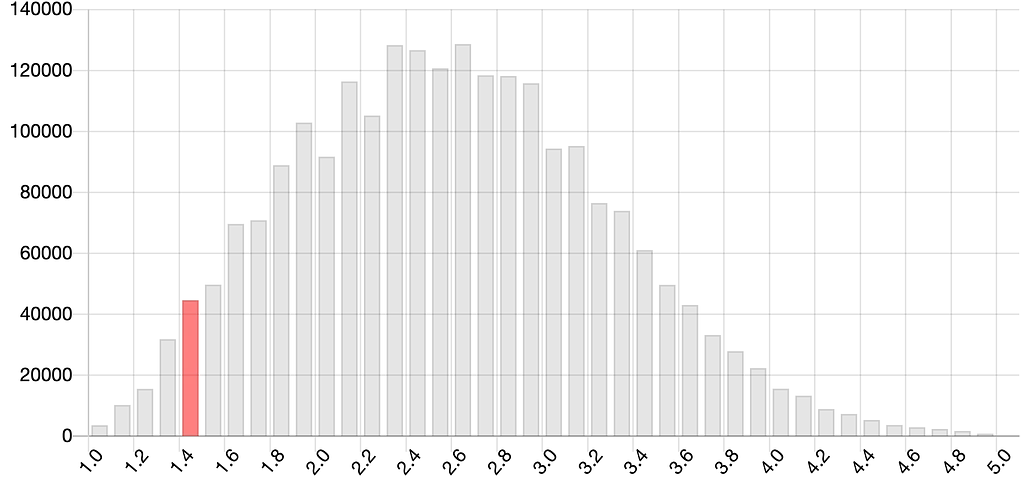
There is another construct called the dark tetrad, which clusters different dark traits together. You’ve probably heard of some of these constructs. These are:
- Machiavellianism — Cold strategic manipulation, long-game scheming, instrumental view of people.
- Narcissism — Grandiosity, entitlement, need for admiration, fragile self-esteem.
- Psychopathy — Callousness, low empathy, impulsivity, thrill-seeking, emotional coldness.
- Sadism — Enjoying causing others pain, discomfort, or humiliation — physically or emotionally. (This was an addition to the former dark triad traits.)
You’ll often find strong language use in the context of dark tetrad personalities. They often invoke vitriol in people. If you’ve had the misfortune of coming under their control or opposing them, they can easily be the worst thing that has ever happened to you. They also tend to be success-seeking, so at some point, they might be your boss or, god forbid, your political leader. But if they have been well socialised (they know how to tick social boxes), the lived reality of the experience can be quite different. The intensity of your lived experience can be invisible to most around you, and sometimes their influence can fly under the radar of people close to them.
I imagine people with dark tetrad traits to be those closest to disconnection in the self-world unitary continuum. They are interesting because they embody an extreme of humanity. They inhabit a reality where society isn’t made up of independent minds and mutual relationships, but a society of complex objects that exist to service their own inner needs, fears, and defences.
When we talk about dark tetrad characteristics, we often focus on extremes that occur at clinical levels, but these traits exist on a spectrum across society. To some extent, we all have moments where we don’t fully engage with the people around us. This is especially true when our life circumstances overwhelm us. It’s just that in the extreme cases, dark tetrad individuals can’t even imagine being any other way.
Let’s take a peek at what that might look like.
Persona 5 — Distortion & Objectification
There’s a great video game called Persona 5 that portrays narcissistic personalities from a Jungian perspective. Each major antagonist has a “Palace,” a symbolic world shaped by their ego defences and distorted self-image. Beneath their cognitive distortions lies a core vulnerability, and the Palace is the mind’s attempt to protect that wounded centre.
The first antagonist, Kamoshida, grew into a predator through his own success. He was a decorated athlete who learned that his talent granted him immunity from accountability. Every trophy and unpunished deviation from the rules by authority figures fed a grandiose self-image that couldn’t tolerate weakness or boundaries of others. He stopped seeing students as people and started seeing them as proof of his dominance.

There are other great antagonists in the game that show a broader spectrum of narcissistic tendencies. Here are a few examples of ‘rulers’ of palaces in Persona 5:
| Ruler | Narcissistic defence | Core fear | How others are seen | Key narcissistic quotes |
|---|---|---|---|---|
| Madarame | Victimhood and covert superiority | Being ordinary or unrecognised | Tools, apprentices and extensions of his genius | “You owe everything to me—without me, you are nothing.” “True art can only be understood by someone like me.” “My suffering made me a genius; these brats should be grateful.” |
| Kaneshiro | Predatory dominance | Being powerless | Piggy banks, resources and liabilities | “You’re all just ATM machines to me.” “Pay up or get crushed.” “People respect power—and I have all of it.” “You exist to make me rich.” |
| Okumura | Hyper-control and mechanised superiority | Chaos, emotions and dependency | Replaceable workers and faulty components | “Employees are units of productivity.” “Failure is unacceptable; failures are disposable.” “Efficiency must be maintained at all costs.” |
| Sae Niijima (Shadow) | Moral superiority (righteous narcissism) | Being wrong or losing status | Cheaters and opponents in her way | “If the system is corrupt, then bending rules is justice.” “Everyone cheats—I’m just evening the odds.” “Only by winning can I prove the truth.” |
An important part of dark tetrad and dark core traits is that people don’t appear as real subjects, but as mirrors, tools, or threats orbiting the fragile gravity of the self, which is very well captured by the game.
In terms of the unitary continuum, their view of the world is really just their projection of themselves and their insecurities. There is very little self-world overlap.
*The game adopts a Jungian perspective on the causes of narcissism. There are various nature vs. nurture debates on the causes a narcissism and dark tetrad traits.*
Dark Self-Transcendence
*This section is rampant speculation! Take it with a pinch of salt.*
At the end of Part I, I talked about zero-sum self-transcendence. That was the idea that individuals seek out distorted versions of self-transcendent experiences. This involves seeking belonging or connection, but by means that are exclusive, conditional and potentially damaging to others. For example, stepping on other people along the career ladder to gain adoration, success and respect.
I’m going to crank that idea up to 11 here and consider much more extreme contexts from the dark tetrad.
Machiavellians
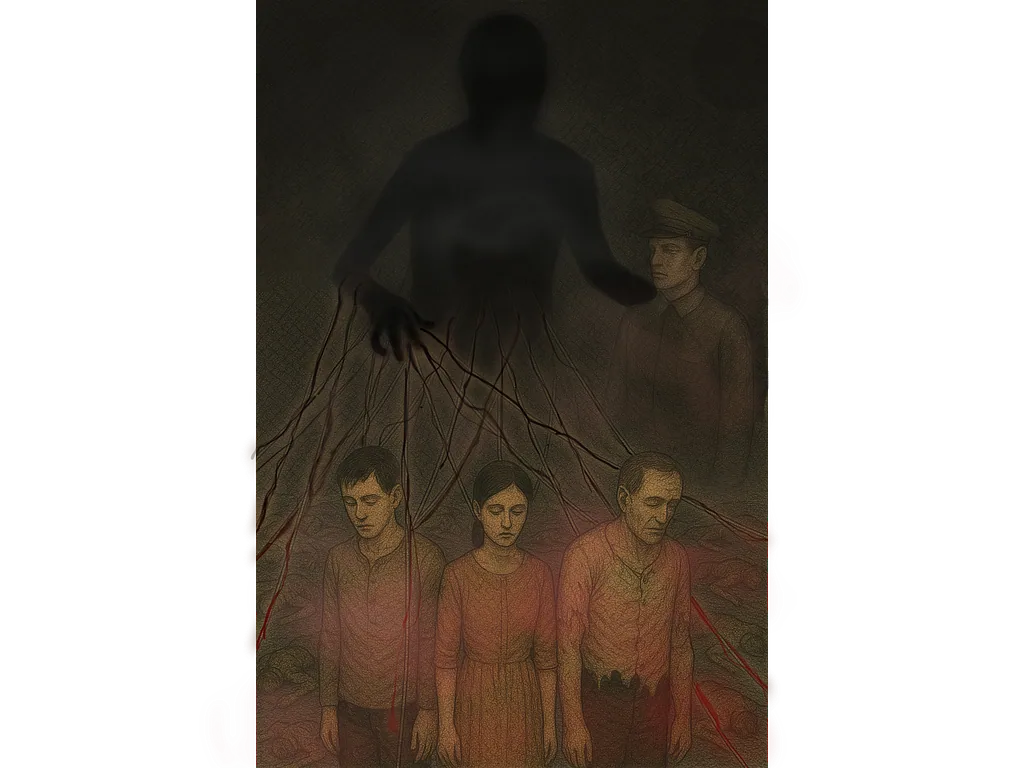
The ultimate drive of a Machiavellian is to understand others so as to control and outmanoeuvre them. They are a sort of dark social anthropologists. This control might consist of mapping insecurities and desires, careful reputation management, alliance tracking, predicting behaviour and building influence networks and storing power in them. Rather than taking control violently, Machiavellians want low-friction control of others: predictable interactions, stable power flows, controlled uncertainty and clean lines of influence. If you are a fan of Game of Thrones, think Little Finger.
They pursue a kind of cognitive empathy (rather than felt empathy) and an understanding that requires a deep embedding within society. They have many qualities that could contribute to society. However, they never really share who they are, because that would make them vulnerable. They tend to cynically believe that everybody else is also playing games and they want to come out on top. The threads that would otherwise connect them to other people are more like puppeteer strings they can pull on.
Serial Killers
There is an urge among some serial killers (and severe sadists/psychopaths) to want to possess their victims as objects. This is the most extreme form of objectification of people. It’s a twisted form of intimacy where there is connection without empathy, oneness without equality, a form of union without surrender to something bigger than yourself and closeness without risk or vulnerability.
“They are part of you … [the victim] becomes a part of you, and you [two] are forever one … and the grounds where you kill them … become sacred to you.” — Ted Bundy
“The killing was a means to an end… I just wanted to have the person under my complete control, not having to consider their wishes, being able to keep them there as long as I wanted.” — Jeffrey Dahmer
These are extremely predatory forms of unity. The fact that they are often ritualised indicates how special these moments are to the serial killers. Where humanity worships unity based on a connection with something higher, (at least some) serial killers worship unity by control and possession of another person.
Narcissists
In some sense, narcissists are hyper-connected to other people. Their self-esteem, identity and emotional stability are entirely outsourced to other people. Other people are said to serve as narcissistic ‘supply’. To a narcissist, every interaction is high-stakes, as their sense of self is always on the line. Because they are in an existential warzone, they need clear friend or foe signalling, which takes the form of excessive admiration; otherwise, they resort to spiteful personal attacks. Furthermore, as they have no real experience of their inner self, they have an underdeveloped self-reflective capacity. In this distorted form of existence, other people don’t exist as independent subjects but as ‘supply’ as a means to satiate themselves.
Narcissist Collectives
Beyond individual actors, narcissists often construct ‘collectives’ around them. These tends to have a particular social structure and beliefs rooted in the logic of the central narcissist:
- Lieutenants (AKA Flying Monkeys) — actively reinforce the narcissist’s distorted narrative. This could be gathering and passing on secrets, taking part in smear campaigns or reinforcing the grandiose ideas of the narcissist (sycophancy).
- Enablers — defending, normalising or diminishing the damage of the narcissist. This can be because of conflict avoidance, dependence on the narccist (often for status), fearing fallout and belief in power structures and the status quo (if the narcissist is in power).
- A shared delusion — being superior somehow, having unique access to the truth, having some shared enemies or opponents, other people are sheep, etc.
The level of integration into these collectives can vary dramatically. In the more scheming version, the inner circle are secret keepers and deliberate implementors, while the outer circle might be unaware enablers. The people involved might compartmentalise this slice of their life and otherwise be normal. So that inward-facing control might also only consume a part of that person.
There tends to be strong in-group, out-group dynamics, often with a largely uncodified but keenly felt code of conduct. Internal behaviours and dynamics that are unsaid but clear enough to know that they should not be enacted in front of outsiders.
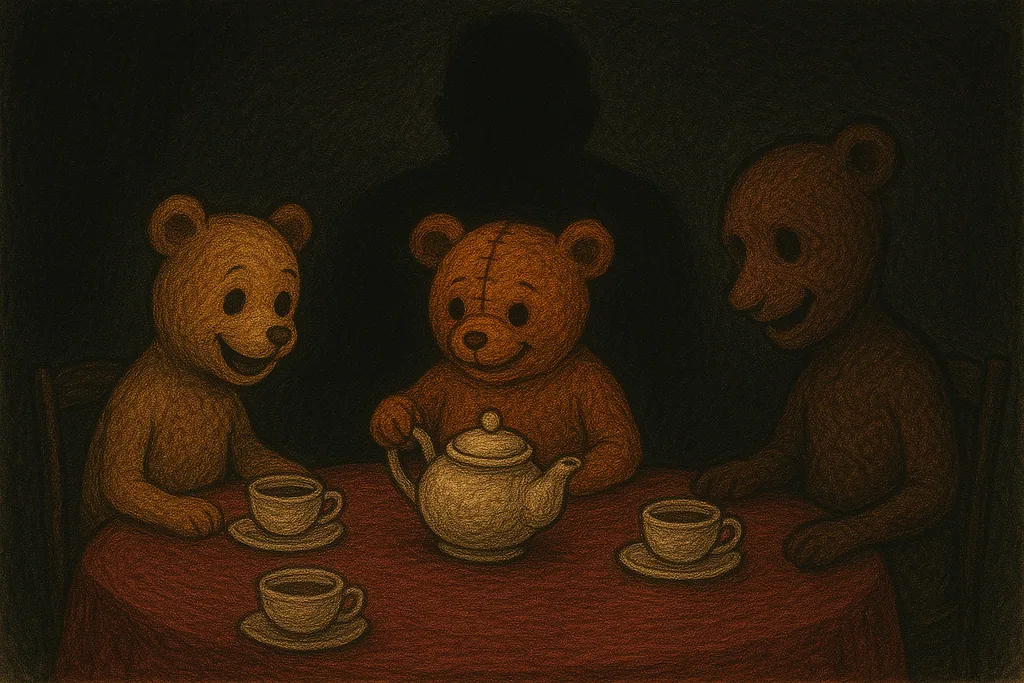
The most inert of these cliques are simply isolating. A chunk of society turned inwards on itself. The promise of some aspect of their individual contributions to society — lost. Their authentic individual spark was drowned out and reshaped into odd teddy bears at the convenience of their host. The most exaggerated versions of these narcissist collectives can spread the distorted delusions into larger groups as distorted cultural or structural changes.
Commonalities
I’m toying with the idea that these examples are, at least in part, different responses to threat-awe. The vast thing here is ‘humanity’ looming over you while the threat comes from the way dark tetrad individuals perceive and relate to the rest of society.
If you really perceived others without affective (felt) empathy or with a very distorted view of other people, you might not have a common sense of purpose and trust in human nature. The world would then become a concrete jungle that you need to dominate and control rather than something you naturally belong to.
There is of course the nature/nurture debate surrounding dark tetrad individuals. It could be that there are only a few steps from the dark suffering we covered earlier, to becoming a predatory/domineering actor. However, I think most people can attest to not being at their best during hardship (especially prolongued hardship). With dark tetrad individuals, there is probably more of a genuine deeply ingrained incapacity to relate and belong to others. Perhaps they went over the event horizon at some point in their lives, or perhaps they never felt connected in the first place.
Final Reflections
When I initially tugged at the thread of ‘awe’ in Part I, I had no idea that it would help me unify various ideas I’ve been thinking about for quite some time.
We’ve now picked up enough puzzle pieces to lay out a map. From disconnection to connection, antisocial behaviour to altruism, objectification to self-dissolution and the lived human experiences that go with it. These are summarised in the following table:
| Self–world | Perception of others | Typical actions | Dominant feeling |
|---|---|---|---|
| Disconnection | Objects or functions—flat internal representations, no recognition of agency; people used for self-regulation or gaining advantage | Manipulation, coercion, deceit, exploitation, violation of others’ rights and antisocial acts | Shame hypersensitivity, constant vigilance for admiration or disrespect, defensive emotional detachment, emptiness requiring external regulation, fear of vulnerability and a projection-dominated perception of self and others |
| Threat & fear | Mirrors or threats—distorted by projection, oscillating between idealisation and contempt, with a fragile theory of mind | Passive aggression, boundary testing, moral justification and control-seeking | Anxiety, resentment, control, excessive self-focus, rumination, emotional numbness and shame–anger oscillation |
| Partnerships | Partners—respected as independent, valued instrumentally, with empathy limited by reciprocity | Cooperative but self-interested acts, fairness within norms and conventional morality | Moderate self-awareness, pragmatic empathy, social attunement, reciprocity and self-interest |
| Collective | Subjects—empathy, curiosity and respect for agency; recognition of inner lives and nurturing | Helping, mentoring, forgiveness, stewardship and creative collaboration | Compassion, gratitude, humility, curiosity and meaning in connection |
| Unity | Part of themselves—non-duality, felt unity of consciousness and a self–other distinction that is dissolved but respected | Altruism, creation, healing, sacrifice and non-dual or contemplative awareness | Awe, serenity, self-transcendence, boundary dissolution and love |
Here, self–world indicates the overlap between the self and world; perception of others describes how other people are experienced; typical actions captures observable behaviour; and dominant feeling describes what these states might feel like from within.
This starts to paint a more complete picture of society with respect to self-transcendence. Taking the wonder-awe concepts from Part I and fleshing them out with the threat-awe concepts we’ve covered in Part II.
Having said that, I’m sure there is plenty more to the story. I’ve taken a single model (the unitary continuum) and seen how far I can push it. It’s been useful, but my current analysis is probably overzealously pushing that idea in one direction.
[1] Yaden, David & Haidt, Jonathan & Hood, Ralph & Vago, David & Newberg, Andrew. (2017). The Varieties of Self-Transcendent Experience. Review of General Psychology.
[2] Bai, Y., Maruskin, L. A., Chen, S., Gordon, A. M., Stellar, J. E., McNeil, G. D., Peng, K., & Keltner, D. (2017). Awe, the diminished self, and collective engagement: Universals and cultural variations in the small self. Journal of Personality and Social Psychology, 113(2), 185–209.
[3] Chen, S. K., & Mongrain, M. (2020). Awe and the Interconnected Self. The Journal of Positive Psychology, 1–9.
[4] Azarias FR, Almeida GHDR, de Melo LF, Rici REG, Maria DA. The Journey of the Default Mode Network: Development, Function, and Impact on Mental Health. Biology (Basel). 2025 Apr 10.
[5] Bernard, Nathanial & Maurer, J & Anderson, Nathaniel & Harenski, Carla & Kiehl, Kent. (2025). The association between psychopathic traits and religiosity/spirituality among incarcerated adults. Personality and individual differences.
[6] Scott Barry Kaufman, The Science of Spiritual Narcissism, The Scientific American, https://www.scientificamerican.com/article/the-science-of-spiritual-narcissism/?utm_source=chatgpt.com, Accessed 14 November 2025.
[7] Gomes O (2025), “Utility under the Dark Tetrad”. Journal of Economics, Finance and Administrative Science, Vol. 30 №59 pp. 22–40, doi: https://doi.org/10.1108/JEFAS-07-2022-0164
[8] Moshagen, M., Hilbig, B. E., & Zettler, I. (2018). The dark core of personality. Psychological Review, 125, 656–688.
[9] Moshagen M, Zettler I, Hilbig BE. Measuring the dark core of personality. Psychol Assess. 2020 Feb;32(2):182–196. doi: 10.1037/pas0000778. Epub 2019 Oct 14. PMID: 31613123.
[10] Chaudhury SH, Garg N, Jiang Z. The curious case of threat-awe: A theoretical and empirical reconceptualization. Emotion. 2022 Oct;22(7):1653–1669. doi: 10.1037/emo0000984. Epub 2021 Sep 16. PMID: 34582240.
[11] Gordon AM, Stellar JE, Anderson CL, McNeil GD, Loew D, Keltner D. The dark side of the sublime: Distinguishing a threat-based variant of awe. J Pers Soc Psychol. 2017 Aug;113(2):310–328. doi: 10.1037/pspp0000120. Epub 2016 Dec 8. PMID: 27929301.
[12] Eisenberger NI. The neural bases of social pain: evidence for shared representations with physical pain. Psychosom Med. 2012 Feb-Mar;74(2):126–35. doi: 10.1097/PSY.0b013e3182464dd1. Epub 2012 Jan 27. PMID: 22286852; PMCID: PMC3273616.