I’ve been working with Assim Kalouaz on his installation “Le Sublime dans l’Art Numérique”. This evidence-based art installation attempts to evoke the feeling of ‘awe’ in its participants. He recently gave a presentation in our Etincelle series at Sony CSL, covering the theoretical background of his experiment. This exposed me to a collection of concepts that I feel begin to paint an interesting picture, though it’s somewhat incomplete.
In this article, I’ll be springboarding across a bunch of concepts, dipping my toes into topics beyond my expertise (so please provide pointers!). I’ll also be borrowing heavily from Assim’s talk.
There will eventually be some statements of my own (mostly in Part II), but let’s unravel this concept gradually. There is a very inviting loose thread that I pulled on, and it led me down an interesting path. Let’s pull on that thread, shall we?

What is Awe?
While awe today usually emphasises wonder, admiration, or being overwhelmed by something vast, etymologically, its roots are quite different. The vestiges of this are still apparent in English. We can observe that ‘awe’ is in ‘awful’ (terrible) as well as ‘awesome’. This is not a coincidental shared prefix. These seemingly conflicting etymological siblings have a common origin.
The modern word ‘awe’ traces back to Old English ege, meaning “fear, terror, dread.” Related to Old High German aga (fear) and Gothic ags (terror, fright). By the Middle Ages, English began to use awe to signify not just fear but a “reverential fear” or a sense of profound respect mixed with fear. If you were a medieval monk writing in Latin, timor (fear) and reverentia (reverence) could both be translated as “awe.” The word carried both the meaning of trembling before god’s majesty and quaking before god’s wrath.
Over time, the language split in curious directions: awful, once meaning “full of awe,” drifted toward “very bad,” while awesome, once meaning “inspiring fear and reverence,” lightened in valence into a casual term of approval. The reverential aspect of the word, reserved for gods and kings, disappeared from both meanings.
What I will argue is that society is becoming more and more awful (in the terrible sense) and that the etymological origin of that word will be quite profound (it was to me). But before going down that route, why don’t we elaborate a little more on the modern usage of ‘awe’ and look at something awesome?
The Overview Effect
The overview effect is a great example of an ‘awe-inspiring’ experience. This is the experience that astronauts have looking down at the planet Earth from space:
Edgar Mitchell (Apollo 14, 1971):
“You develop an instant global consciousness, a people orientation, an intense dissatisfaction with the state of the world, and a compulsion to do something about it. From out there on the moon, international politics look so petty.”
Nicole Stott (ISS, 2009):
“It makes you feel like you want to take care of it. It makes you feel like you want to take care of all the people on it.”

So what is that feeling? I’m sure more complex definitions exist but for the sake of simplicity, let’s say that
Awe is…
… a combination of three factors:
- Vastness (something perceptually or conceptually larger than the self)
- Need for accommodation (your mind has to stretch or reorganise to make sense of it)
- Changing values (your priorities change)
The ‘vastness’ aspect of the overview effect is not merely a fact (this is big) but a raw phenomenological experience. You aren’t just watching a movie or looking at pictures, you feel ‘part’ of something. Why this is the case is myterious to me. What practical purpose does it serve? The vast ‘thing’ is much larger than your capacity to act on it.
So what are the shifts in experience/attitudes that occur? Among others there are a couple of dominant outcomes:
Self-diminishment:¹: Relative to this vast thing, you become small. Your problems become vanishingly less important the smaller you are.
Prosocial orientation:² A sense of interconnectedness and joint responsibility (save the planet).
I’m not sure when I’ll be able to see the Earth from space myself, but I imagine that feeling is quite similar to the sense of wonder I get when reflecting on the endlessness of the universe or when being humbled by the small slice of human history against that backdrop of all life on earth.
I do want to make a quick aside here, though…
… on Meditation
Though I don’t do it often enough, I do meditate.
My practice consists of willfully expanding my awareness throughout my body and into my surroundings. It’s a bit like becoming the rawest perceptual sensor you can be. Once you’ve dialed up your sensitivity levels, the experience of meditation is then a stream of sensory experiences navigated by your attention.
On reflection, my meditative practice frequently overlaps with the feeling of ‘awe’. Perhaps ‘vastness’ doesn’t need to be a large spatio-temporal entity. It just needs to be an experience that saturates your perceptual field. In meditation, even in the quietest moments, this perceptual saturation can be quite intense.
In light of this, certain imagery and metaphors begin to make more sense. For example, here are some lines from a famous British poet:

Perhaps experiences like the overview effect are what are necessary to forcibly shake us out of our mind’s automatic algorithms. The sheer strength of the signal overrides our default programming. Indeed, some research on awe has shown that it corresponds to a reduction in ‘default mode network’ (DMN) activity.⁴ This is the network where rumination/daydreaming occurs, capturing much of our internally focused cognition — autobiographical thought, moral reasoning, etc.
Meditation, in contrast to being blasted out of nowhere by something beautiful and vast, is a wilful path to that sort of experience.
The Unitary Continuum
Does anything out there support my observation about the relationship between awe and meditation?
Well, David Yaden suggests a conceptually simple model that does. This is a model of self-transcendence. In this model, meditation (or mindfulness) and awe are positioned along a continuum. “The Unitary Continuum”⁵ is a function of the overlap between the self and the world. Self-transcendence is then an overlap between oneself and the world.
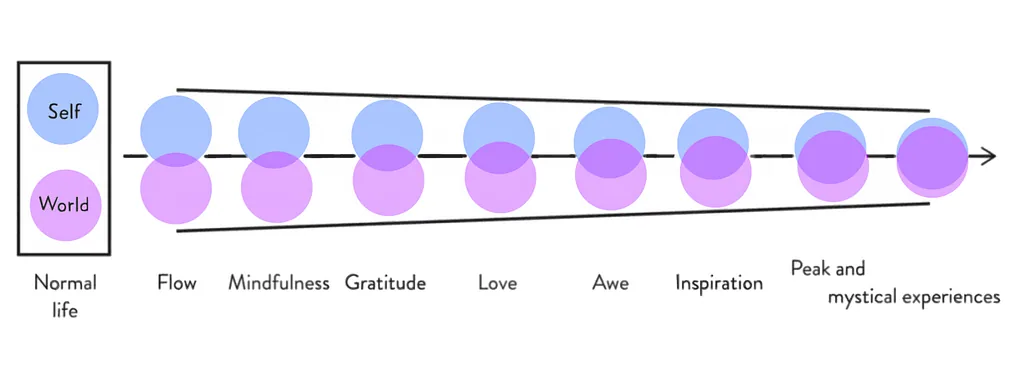
In this continuum, ‘awe’ is among the more extreme self-transcendent experiences, while mindfulness is earlier on in this continuum. It also allows for more mundane forms of self-transcendence. I don’t think the particular labels and their positions need to be set in stone.
I’ll take a liberty with my interpretation of this continuum. That the ‘world’ here includes your relationship with the rest of humanity as well as your environment.
**Disclaimer: While the post was largely inspired by Assim’s presentation and research up to this point, I’m deviating far from it from now on and in Part II.**
Does Awe Diminish the Self?
I don’t want to throw down the gauntlet just yet, but I suspect that the ‘self-diminishment’ part of awe might in fact be a shift in self rather than a reduction of self. We might be in danger of fixating on an ontologically privileged idea of what the ‘normal’ self is. For one thing, I imagine that the notion of ‘self’ varies a lot inter/intra-culturally.
As a quick example, Knyazev⁶ found that people who endorse individualist values tend to show stronger default mode network (DMN) connectivity when thinking about themselves, whereas those who endorse more collectivist values show stronger DMN connectivity when thinking about others. I’m sure there are many other results out there demonstrating these sorts of variations.
Perhaps, it would even be possible to have a self-transcendent self. That is, a self, organised around states of being that are considered self-transcendent. This self-transcendent self is obviously paradoxical, though I suspect it might be a real phenomenon. That is, people who have changed significantly as a consequence of self-transcendent experiences. This suggests that the terminology of ‘self-transcendence’ might require better articulation, though that is probably best left up to the experts.
What is Normal Self-Transcendence?
I take a little bit of issue with the idea that “normal life” in the unitary continuum is a non-overlapping relationship. That would be complete alienation from the world and other people by my book. I think there is always some level of self-transcendence that we do have; it’s just that we take it for granted. Or, perhaps, the self-transcendence that is there is a somewhat distorted and pathological version of itself.
So, what might this ‘normal’ self-transcendent experience look like?
Extension into your community:
- Belonging to your slice of society, e.g. your family, your profession, where you come from, your accent, etc.
- Apprenticeship/mentorship: feeling part of a lineage of knowledge.
- Moments of collective rhythm: singing in a choir, chanting at a protest, even cheering in a stadium.
Extension into your environment:
- The feeling of ‘belonging’ to your neighbourhood or the place you grew up.
- The warm feeling you get from your collection of paraphernalia. E.g. stamps, coins, etc.
- Encounters with weather: a sudden storm, the first snow of the season, or being caught in heavy rain.
- Shared silence with a landscape, e.g. watching a sunrise, listening to birds at dawn.
At the Edge of Breakdown
One could argue that identity-based relationships, such as being part of a group (nationality, profession, neighbourhood, etc.), are not self-transcendent. These relationships could shackle the self, rather than shrinking/transcending it. Another take on the idea is that identity-based belonging is a kind of local transcendence — a smaller fractal repeating the pattern of the whole, but bounded within its own edges.
Somewhere in the ‘normal life ’, there is the potential for somewhat dysfunctional/distorted types of self-transcendence. Though these are very common, they can begin to become pathological at the individual or societal level.
Some examples:
- Self-expansion Through Possessions — Where each new upgrade or luxury is a claim to belong to a group. The more people who have those things, the less valuable you are. Therefore, you want most people to have less than you do.
- Environmental conquest — The domination of nature, such as hunting animals as trophies or owning more land. You exploit what you can connect with. Perhaps motivated by the desire to be admired by others elsewhere.
- Elitist competition — Unsportsmanly behaviour to be part of an elitist group. You might not even like the people around you, but you like the perceived prestige.
A lot of this is a matter of intention. One record-breaking athlete might see their achievement as lifting up all of humanity, while another might take it as proof they alone deserve adulation, and they can’t stand the idea that anybody else could outcompete them. The latter case is a sort of zero-sum self-transcendence, where your perceived value increases at the expense of others.
This sets me up nicely for Part II, which will explore the ‘aw-ful’ part of awe.
Tune in next time!
[1] Bai, Y., Maruskin, L. A., Chen, S., Gordon, A. M., Stellar, J. E., McNeil, G. D., Peng, K., & Keltner, D. (2017). Awe, the diminished self, and collective engagement: Universals and cultural variations in the small self. Journal of Personality and Social Psychology, 113(2), 185–209.
[2] Piff, P. K., Dietze, P., Feinberg, M., Stancato, D. M., & Keltner, D. (2015). Awe, the small self, and prosocial behavior. Journal of Personality and Social Psychology, 108(6), 883–899.
[3] Keltner, D., & Haidt, J. (2003). Approaching awe, a moral, spiritual, and aesthetic emotion. Cognition and Emotion, 17(2), 297–314.
[4] van Elk M, Arciniegas Gomez MA, van der Zwaag W, van Schie HT, Sauter D. The neural correlates of the awe experience: Reduced default mode network activity during feelings of awe. Hum Brain Mapp. 2019 Aug 15;
[5] Yaden, David & Haidt, Jonathan & Hood, Ralph & Vago, David & Newberg, Andrew. (2017). The Varieties of Self-Transcendent Experience. Review of General Psychology. 21. 10.1037/gpr0000102.
[6] Knyazev, Gennady. (2021). Self- And Other-Referential Processing: fMRI Functional Connectivity Study. International Journal of Psychophysiology. 168. S67. 10.1016/j.ijpsycho.2021.07.206.