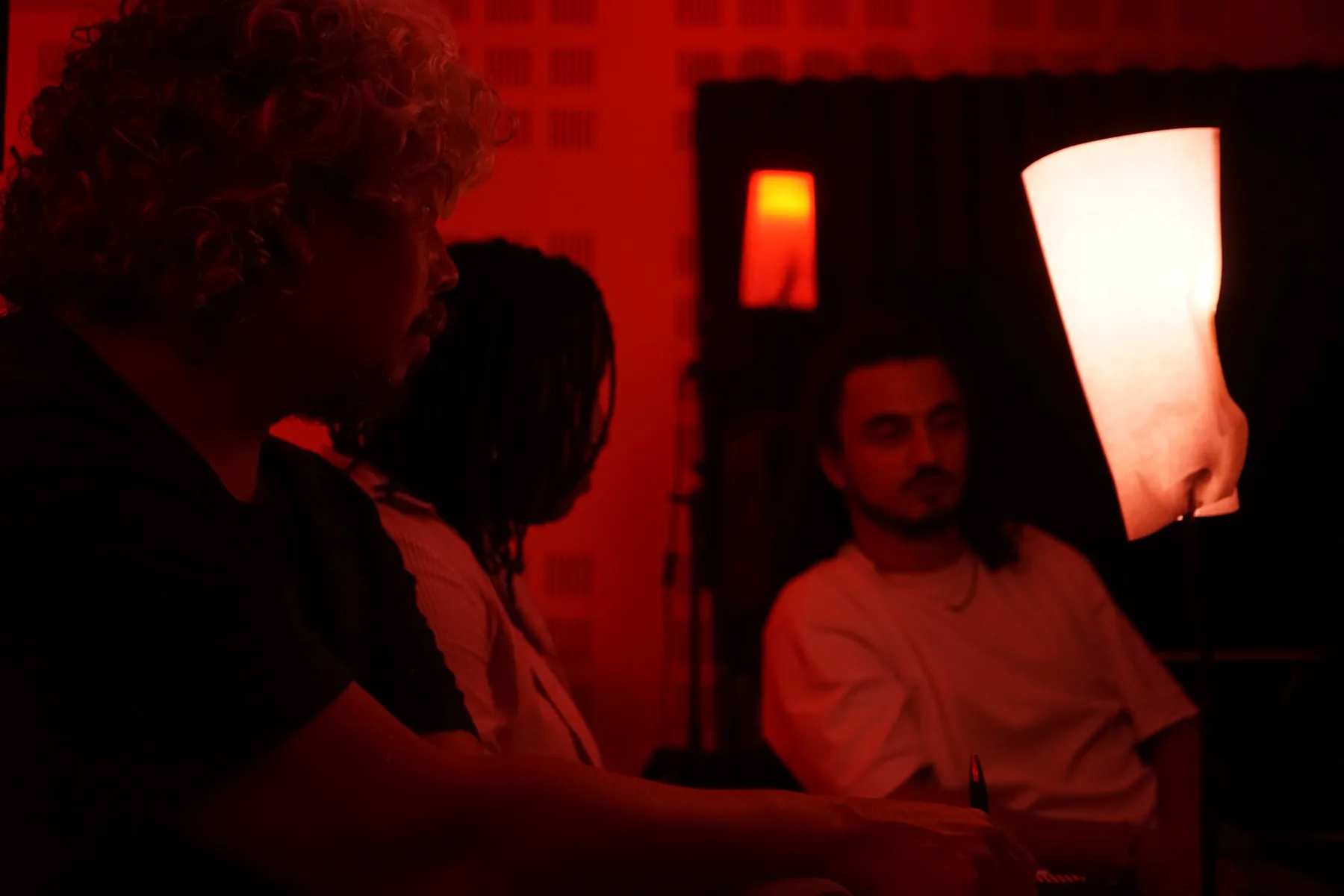
After running two sessions of The Lighthouse, Guillaume Boulliard and I asked the players what they had imagined, which moments had worked and where the experience had broken down. Their responses helped us evaluate both the physical setup and the lighting scenes.
How we collected the feedback
We used a group interview format after the two sessions. Rather than interviewing each participant separately, we posed questions to the whole group and left plenty of space for open-ended responses and discussion between participants.
We recorded the conversation on a mobile phone, then used Vibe to produce an initial automatic transcription. We checked that transcript by hand against the recording before extracting and grouping the responses discussed below. The quotations are left unattributed to individual participants.
This approach gave us rich qualitative material, including moments when participants agreed, challenged one another or developed an interpretation together. It also means that one person’s answer may have influenced what others remembered or described.
Most participants had technical backgrounds and little experience with tabletop roleplaying. They were likely to be unusually interested in the technology and relatively forgiving of an early-stage system. It was also difficult to separate enjoyment of Funiki from the novelty of tabletop roleplaying itself.
The interviews were informal and exploratory rather than a controlled study. The resulting data provides general impressions and directions for future work, not definitive evidence. It was still valuable: the players described not only whether they enjoyed the experience, but how light and sound had shaped the spaces in their heads.
Atmosphere without illustration
The strongest response was to the atmosphere. One participant said, “I was very happy to discover a new atmosphere.” Another felt that “when you have the sound synchronized with the light, it’s really great.”
The lights did not dictate a literal image. Players described them more like clues or conditions for imagining: enough information to establish darkness, movement, danger or warmth while leaving the details open. One comparison was to reading a book, where each person constructs a different version of the same described place.
That balance matters. A tabletop game depends on shared imagination, but it does not require everybody to picture an identical room. The lighting was most effective when it gave the group a common emotional and spatial foundation without trying to become scenery.
“Now I can’t play any more role play games without lights.”
Sound completed the cue
Participants consistently connected light with sound. The electrical hum explained the flicker. A match and gentle popping made a warm lamp read as flame. Waves, a creaking door and the rotating beam established the coast outside the lighthouse.
People even remembered sounds that were not actually present. This suggests that the cues combined semantically: once light, narration and a few sounds established a coherent event, imagination supplied some of the missing detail.
The limitation was equally clear. The single speaker could not create the same spatial movement as the lamps, and several players wanted the audio to be louder or to surround them. A future version should treat spatial sound as part of the scene’s geometry, not simply as accompaniment.
Imagined space is physical
Players tried to reconcile the fiction with the room around them. They asked whether the lighthouse beam should be visible from inside, disagreed about which floor they occupied and imagined rooms at different scales.
Their actual positions mattered too. During the taxi scene, the direction in which people sat around the table sometimes conflicted with the direction they imagined the vehicle moving. By contrast, the lighthouse roof was one of the clearest shared spaces: a central rotating light and a concrete task gave everyone a stable point of reference.
Darkness changed perceived scale. When candlelight allowed the room’s boundaries to disappear, the imagined space felt larger. This was a useful reminder that an absence of visual information can be an active design tool.
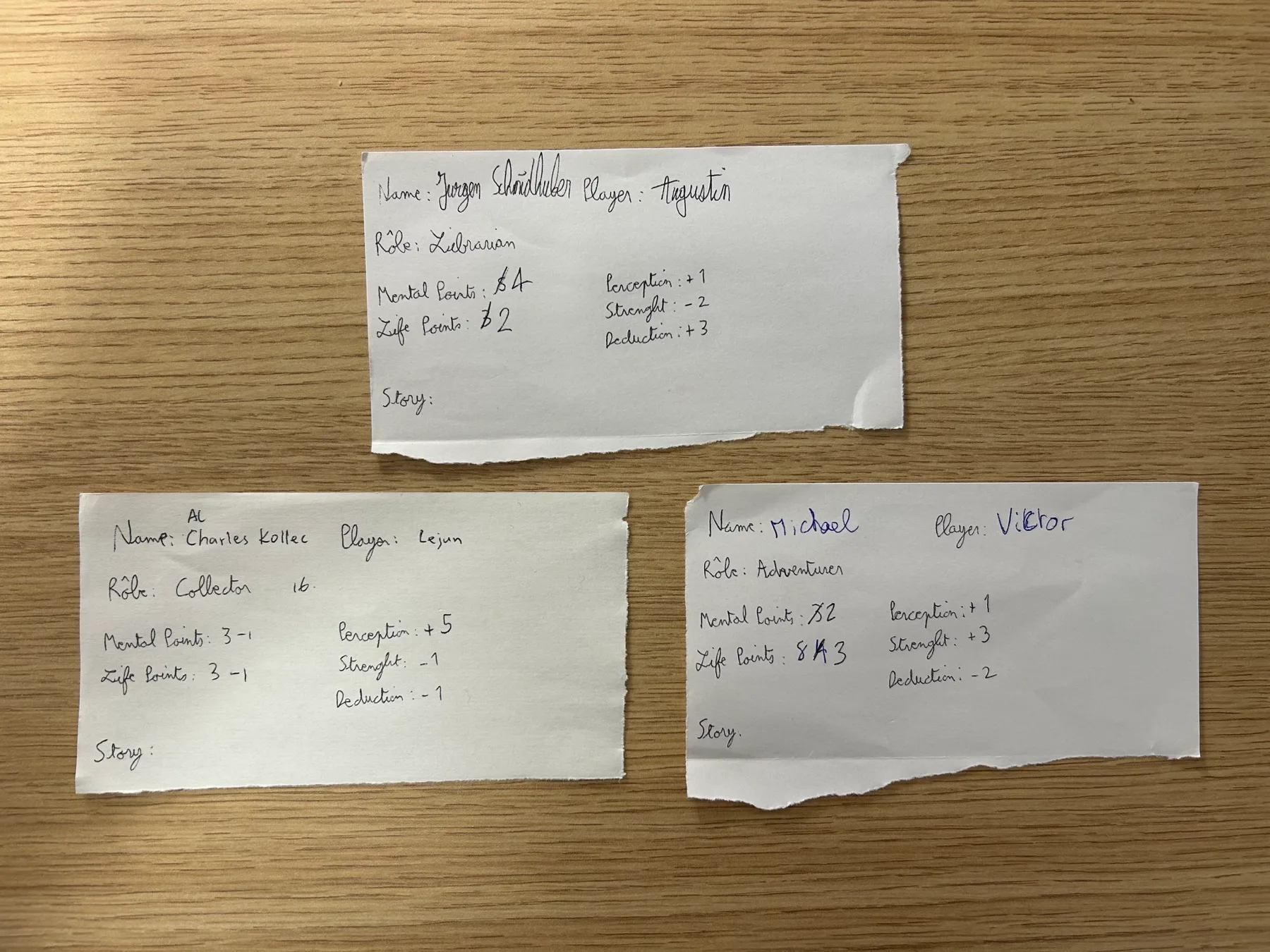 Character sheets from the first session.
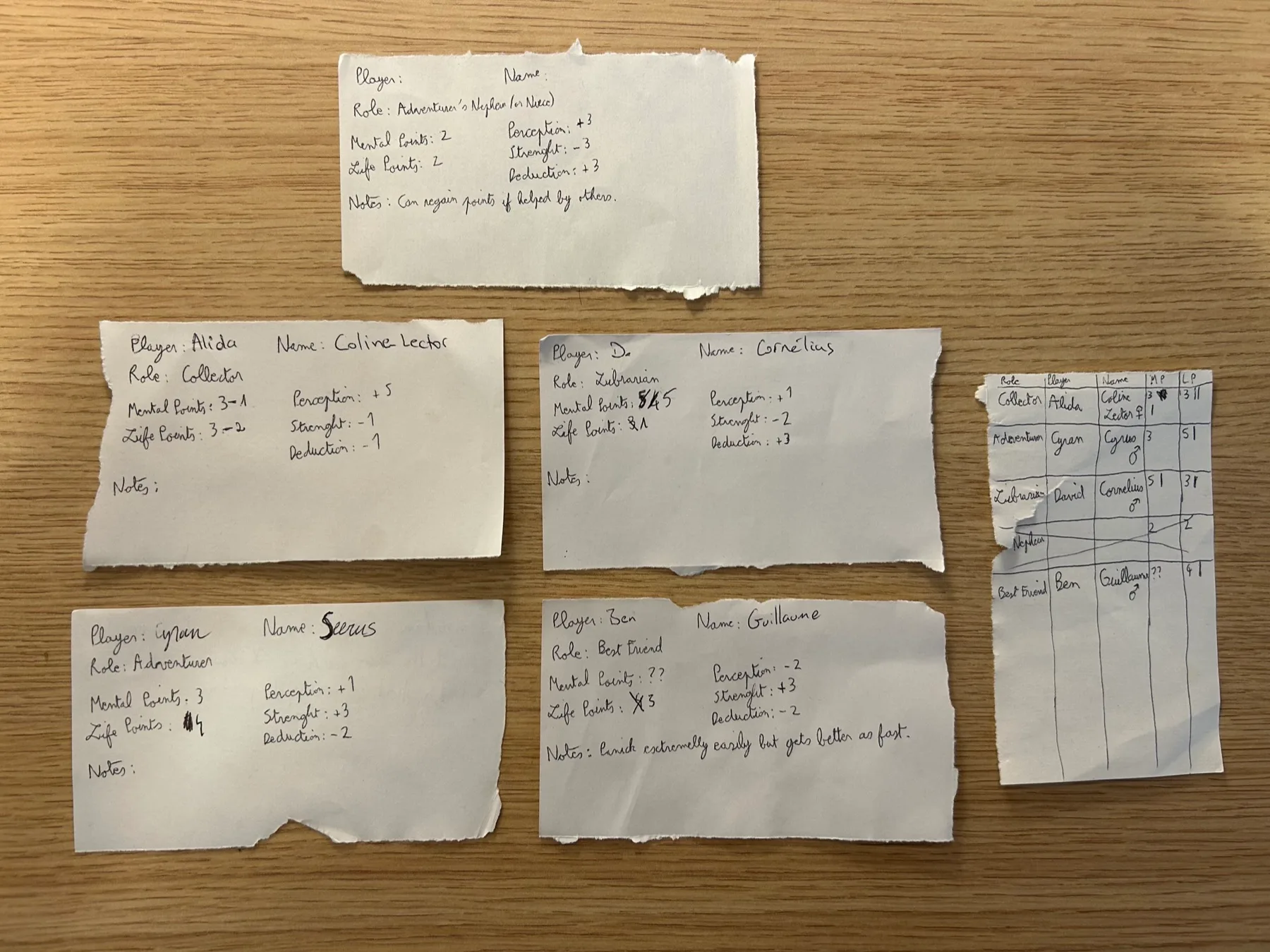 Character sheets from the second session.
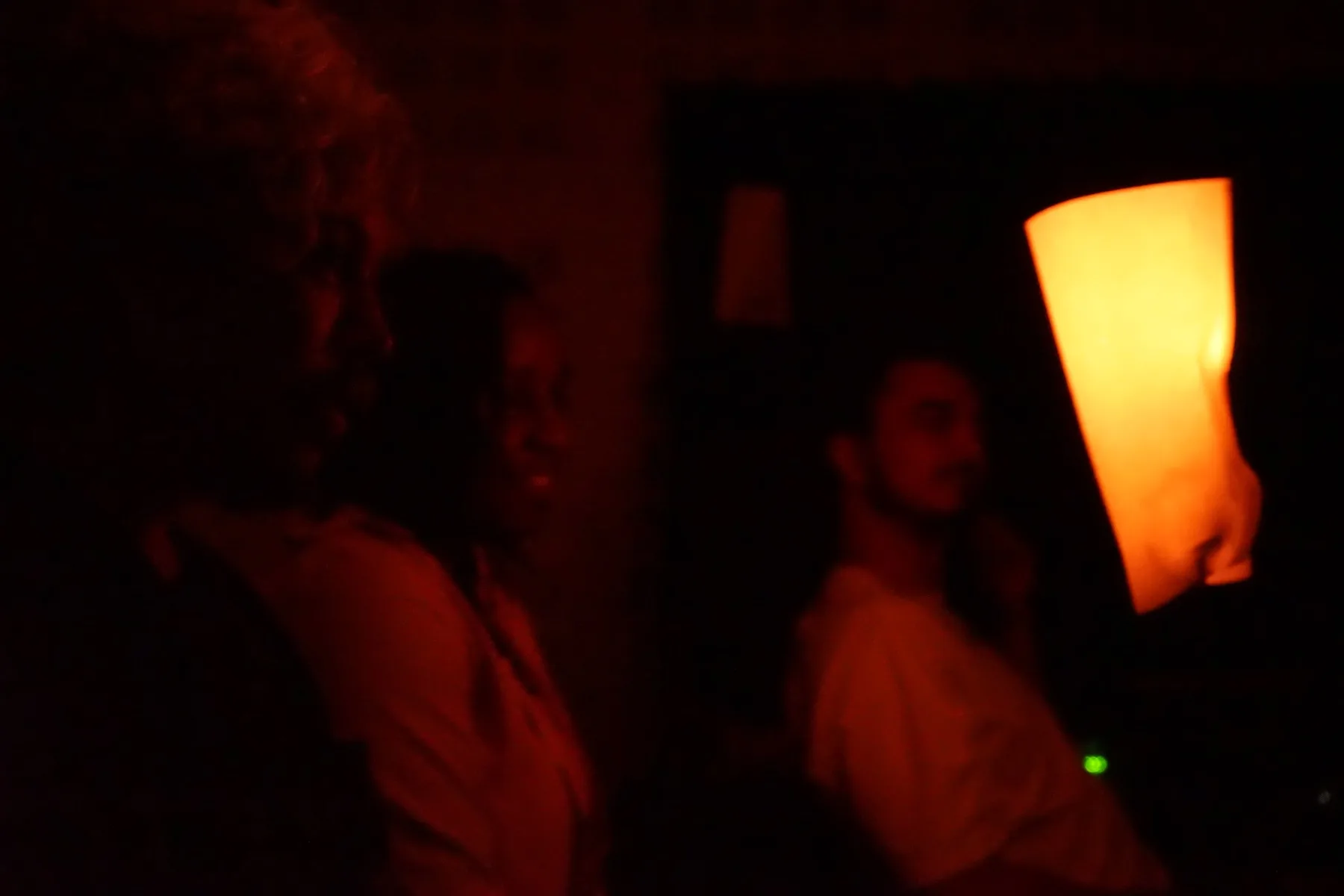 Darkened boundaries made the imagined room feel larger.
 The red “lights out” sequence felt scary without feeling unsafe.
What worked scene by scene
The village produced an unexpectedly consistent image. Several players independently pictured a single stone street in Brittany, despite the scene remaining largely descriptive.
Outside the lighthouse, the combination of darkness, waves, a moving white beam and the opening door created one of the strongest transitions. The blackout and red-light sequence was also memorable: unsettling enough to produce tension while remaining “safely scary”.
Combat was less successful. Static ambience could establish a threatening mood, but it did not express the disorder or movement of a fight. Players wanted faster, more chaotic light and sound. One suggestion was to let the spirit move through lamps around and behind them, turning the room itself into an opponent.
Five lessons
1. Use light as a prompt
Colour, direction and rhythm can establish the conditions of a scene without illustrating every object. That openness preserves the imaginative work that makes roleplaying compelling.
2. Synchronisation creates meaning
A light effect becomes much easier to interpret when narration and sound change with it. The important unit is not an individual lamp or audio file, but the combined cue.
3. Keep the spatial logic coherent
People build a mental map even when no map is shown. Moving effects need to respect that map, the players’ orientation and the implied location of sources.
4. Match the behaviour to the action
Slow ambience worked for travel, exploration and suspense. Combat needed a different visual language: movement, interruption and unpredictability.
5. Design darkness as carefully as light
Reducing information can enlarge a space, redirect attention and make a small source feel important. The candle scene worked because the darkness around it was doing as much as the lamp itself.
The clearest result was not that more effects are always better. A few legible, coordinated cues gave players material to imagine with. The next challenge is to make those cues more spatially coherent—and to give sound the same expressive range as light.