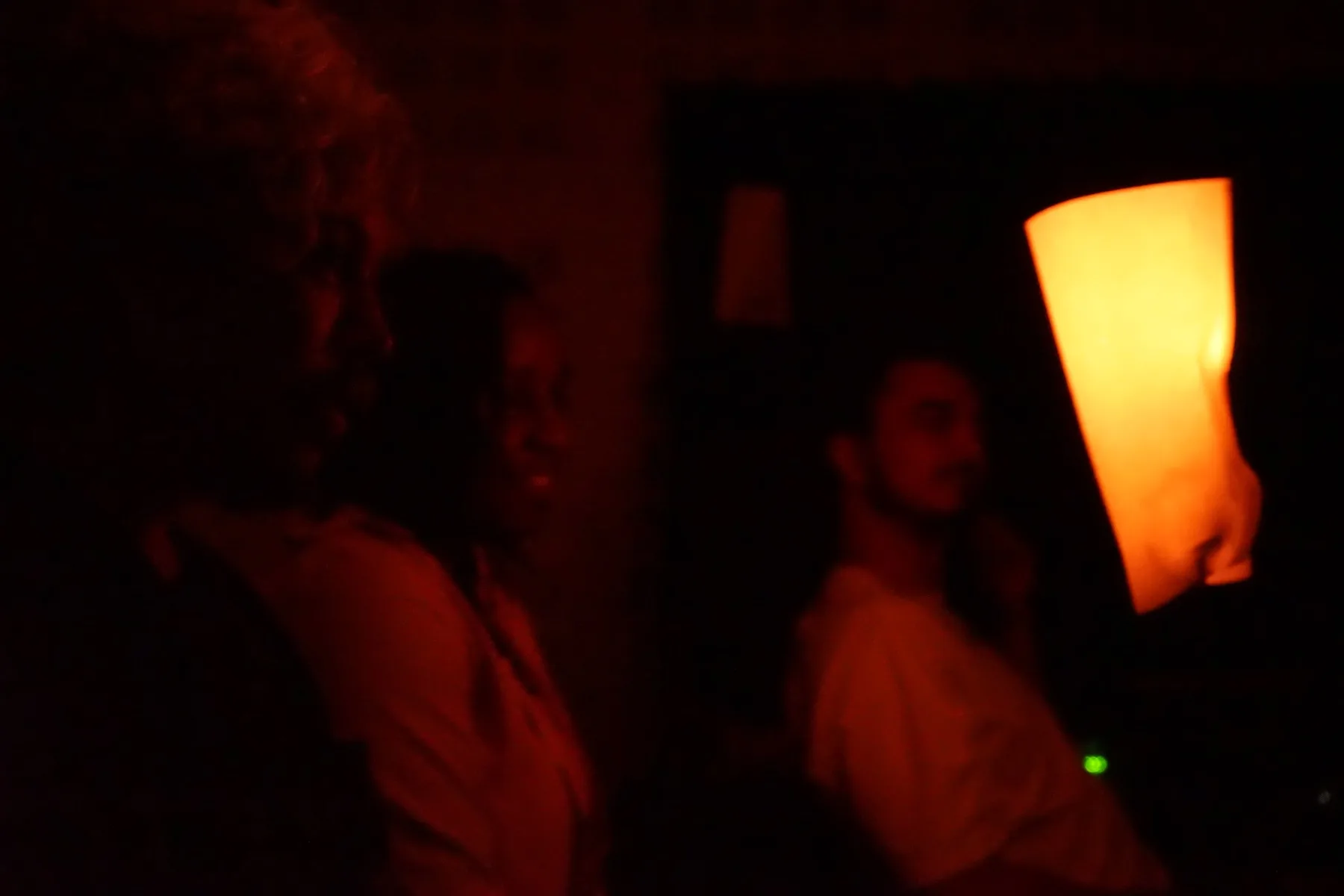
Once the story and physical setup were in place, we translated Guillaume Boulliard’s storyboard into scenes in Funiki. The most successful effects were technically simple enough to read immediately, but spatial enough to make the room feel active.
The taxi
The road stretched ahead in darkness, a ribbon of asphalt swallowed by night. The taxi rolled forward with a steady hum, its engine a low mechanical heartbeat beneath the murmured conversation inside. Every so often, a street lamp loomed into view, a pale halo in the distance that swelled, washed the interior in sodium gold, then slipped behind them. In those brief floods of light, faces were revealed in fragments before the darkness reclaimed them, and only the rhythm of tires on tarmac remained.
When the taxi finally slowed, its headlights cut hard beams through the night air, catching drifting dust and the faint mist rising from the roadside. The doors opened with a dull mechanical click. The players stepped out and found themselves standing in the glare, silhouettes at first, then fully exposed in the stark white light. The engine idled.
Then the taxi pulled away. The white beams vanished, replaced by the deep red glow of retreating brake lights. That red light washed over the group like the last warmth of a dying fire, staining clothes and skin in a quiet, unnatural hue. The engine noise dwindled, the lights shrank, and the glow faded into nothing. What remained was the cool blue of night, soft, enveloping, and vast.
The opening taxi journey gave the players time to discover their characters while the world established its rhythm around them. The sequence moved through four lighting states:
- Warm street lights periodically passed the group as the taxi travelled at night.
- Bright white headlights illuminated the players when they stepped out.
- Red tail lights washed over them and faded as the taxi drove away.
- Cool blue light remained, establishing the village at night.
The virtual scene required little more than a faint directional light overhead and two animated spotlights moving past the group. The changing colour, direction and accompanying engine sound did most of the narrative work.
The movement was intentionally abstract. No image of a road or vehicle was shown, but the repeated sweep of light gave the players a rhythm they could interpret as travel.
The following tethering view shows the same keyframe animation from inside Funiki. Outputs sent to the physical lights are grouped on the left and inputs sampled from the virtual sphere on the right, arranged to make the movement across the room easier to follow.
Approaching the lighthouse
They stood before the lighthouse, its towering silhouette carved against the night sky. The great lantern above revolved with patient inevitability, and every few seconds its beam swept across the rocks, the grass, and finally over them. Each pass was different. One moment they were swallowed in deep coastal blue, shapes barely distinguishable; the next, they were caught in a hard white arc of light, shadows thrown long and sharp behind them. The sea answered with a distant, rhythmic crash, and the wind carried salt and the faint metallic groan of the turning mechanism high above. In those brief illuminations, their figures seemed frozen, travelers paused on the threshold, before darkness folded back in.
They approached the heavy wooden door and knocked, the sound dull and resonant against the stone. For a heartbeat, nothing answered but the wind. Then a warm seam of light appeared along the edges of the door, thin at first, then widening as it slowly creaked inward. The golden interior glow spilled out across the ground and over their faces, softening the harsh lines left by the rotating beacon. For a moment the two lights overlapped, the cold, sweeping brilliance of the lighthouse beam crossing the steady amber from within, bathing them in shifting layers of white and gold. Hinges groaned. The sea roared again. And as the door opened fully, the boundary between the vast, indifferent night and whatever waited inside began to dissolve.
Outside the lighthouse, dark blue perimeter light represented the coast at night while a white overhead source suggested moonlight.
The rotating beacon was built with a keyframe animation. Surrounding lights changed to white at staggered times, making a beam appear to move across the physical room. Guillaume paired it with an abstract sound that gave each pass its own presence and hinted that there was something unusual about the lighthouse.
When the players knocked, a steady amber light opened on one side of the room like an interior doorway. The cold moving beam continued to cross that warmer light, making the threshold feel like a boundary between two places.
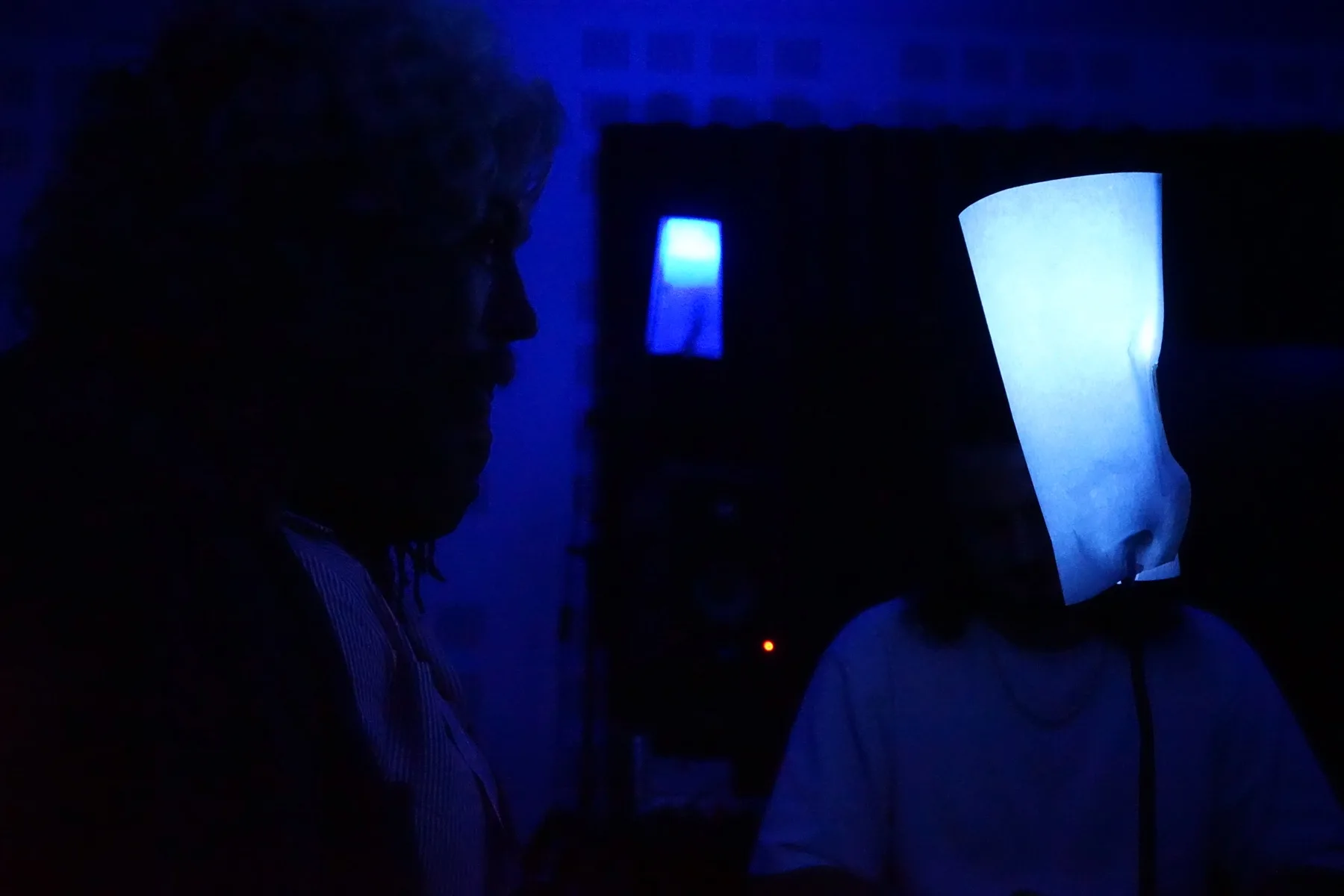 Cool perimeter light establishes the coast at night.
 A local warm source becomes the party’s torch.
 Red light signals that the restored power is not normal.
Lights out
As the adventurers step inside the lighthouse, they are met by the low, persistent hum of an aging electrical system. The sound is steady at first, the vibration of an overworked transformer and current moving through corroded copper wiring installed long ago. Overhead lamps flicker intermittently, their filaments reacting to subtle drops and surges in voltage as the system struggles to regulate power.
The air seems tense. Each surge draws a sharper buzz from the fixtures. Each dip causes the light to dim, hesitate, and flare back. Somewhere within the walls, insulation has hardened with age, connections have oxidized, and the total load on the circuit exceeds what it was designed to carry. The fluctuations grow stronger. The hum deepens in pitch. The flickering accelerates into erratic pulses as voltage oscillates beyond safe limits.
Then comes a sudden metallic snap. A fuse ruptures under thermal stress, the circuit opens, and current ceases instantly. The humming stops. Darkness fills the chamber.
After a brief silence, one of the adventurers strikes flint to steel. A torch catches, its flame steady and chemical in its certainty. Unlike the strained electric light, the fire burns with stable convection and radiant heat. They advance by its warm glow, carrying that simple, reliable illumination with them as they continue deeper into the lighthouse.
Inside the lighthouse, a low electrical hum and occasional flickers primed the players to notice the lighting system. The flickering then became increasingly unstable before every electric light cut out at once.
The effect was controlled programmatically in Godot. Several lights were placed around the centre of the virtual scene, and each varied its attenuation during short bursts: 0 for normal light, between -0.1 and -1.0 for a flicker, and 10 for off. Attenuation controls how light falls off over distance, so increasing it lets less light reach the Lambertian sphere from which the tethered physical lights sample their values. Godot also permits negative attenuation, which makes a light brighter.
The system exposed controls for:
- the minimum and maximum delay between bursts;
- the duration of each burst;
- the number of flickers within it;
- the normal, flickering and switched-off attenuation values;
- and a final override that killed every light.
Most of those controls were animated with keyframes, while the code handled the irregular flicker within each phase. For the blackout, the flicker attenuation moved from -0.1 towards -1, making each burst brighter and denser before every light was switched off at once.
The flickering light class is a small state machine. It waits for a randomised interval, runs a burst of evenly spaced toggles between the normal and flicker values, then returns to waiting. The kill switch overrides everything.
using Godot;
using System;
using System.Collections.Generic;

public partial class FlickeringLight : Node
{
    // -----------------------------
    // Inspector (Exports)
    // -----------------------------

    [ExportGroup("Light list")]
    [Export] private SpotlightOnSphere[] _lights = Array.Empty<SpotlightOnSphere>();

    [ExportGroup("Boolean Control")]
    [Export] public bool ActivateFlickering = false;
    [Export] public bool KillAllLights = false;

    [ExportGroup("Time between flickers")]
    [Export] private float _minIntervalSeconds = 2f;
    [Export] private float _maxIntervalSeconds = 4f;

    [ExportGroup("Flicker Burst Properties")]
    [Export] private float _burstDurationSeconds = 0.5f;

    [Export] private int _minTogglesPerBurst = 4;
    [Export] private int _maxTogglesPerBurst = 8;

    [ExportGroup("Attenuation Values (your convention)")]
    [Export] private float _normalAttenuation = 0f;      // Normal steady value
    [Export] private float _flickerAttenuation = -1f;     // Value used during flicker phase
    [Export] private float _killedAttenuation = 10f;      // Forced-off / killed value

    [ExportGroup("Interval randomization")]
    [Export] private bool _useNormalDistributionForInterval = false;
    // If true: uses Randfn(mean, stddev) with:
    [Export] private float _intervalMeanSeconds = 3f;
    [Export] private float _intervalStdDevSeconds = 0.5f;

    // -----------------------------
    // Internal state machine
    // -----------------------------

    private enum FlickerState
    {
        Disabled,   // flicker logic off; keep lights at normal attenuation
        Waiting,    // waiting for next burst
        Bursting    // currently running a burst (toggling attenuation)
    }

    private FlickerState _state = FlickerState.Waiting;

    // Waiting state
    private float _timeSinceLastBurst = 0f;
    private float _nextBurstDelay = 0f;

    // Bursting state
    private float _burstTime = 0f;
    private readonly List<float> _flipTimes = new(); // times within burst when we toggle
    private int _nextFlipIndex = 0;
    private bool _useNormalAttenuationThisPhase = true;

    public override void _Ready()
    {
        // Start in a consistent state.
        _state = FlickerState.Disabled;
        _timeSinceLastBurst = 0f;
        _nextBurstDelay = SampleNextIntervalSeconds();

        ApplyAttenuationToAll(_normalAttenuation);
        ActivateFlickering = false; // By default the lights don't flicker.
    }

    public override void _Process(double delta)
    {
        float dt = (float)delta;

        // 1) Hard override: kill lights always wins.
        if (KillAllLights)
        {
            ApplyAttenuationToAll(_killedAttenuation);
            _state = FlickerState.Disabled; // freeze flicker logic while killed
            return;
        }

        // 2) If flickering is disabled, keep a steady value and exit.
        if (!ActivateFlickering)
        {
            ApplyAttenuationToAll(_normalAttenuation);
            _state = FlickerState.Disabled;
            return;
        }

        // If we were disabled and flicker got re-enabled, resume waiting.
        if (_state == FlickerState.Disabled)
        {
            EnterWaitingState();
        }

        // 3) Run the state machine.
        switch (_state)
        {
            case FlickerState.Waiting:
                UpdateWaiting(dt);
                break;

            case FlickerState.Bursting:
                UpdateBursting(dt);
                break;
        }
    }

    // -----------------------------
    // State updates
    // -----------------------------

    private void UpdateWaiting(float dt)
    {
        _timeSinceLastBurst += dt;

        if (_timeSinceLastBurst >= _nextBurstDelay)
        {
            StartBurst();
        }
        else
        {
            // Optional: ensure lights stay normal while waiting.
            // (If other systems can change attenuation, keep this line.
            // Otherwise you can remove it to save writes.)
            ApplyAttenuationToAll(_normalAttenuation);
        }
    }

    private void UpdateBursting(float dt)
    {
        _burstTime += dt;

        // End of burst: restore, then go back to waiting.
        if (_burstTime >= _burstDurationSeconds)
        {
            ApplyAttenuationToAll(_normalAttenuation);
            EnterWaitingState();
            return;
        }

        // Toggle phase when we pass scheduled flip times.
        // While-loop = catch-up if dt is large (lag spikes).
        while (_nextFlipIndex < _flipTimes.Count && _burstTime >= _flipTimes[_nextFlipIndex])
        {
            _nextFlipIndex++;
            _useNormalAttenuationThisPhase = !_useNormalAttenuationThisPhase;
        }

        float attenuation = _useNormalAttenuationThisPhase ? _normalAttenuation : _flickerAttenuation;
        ApplyAttenuationToAll(attenuation);
    }

    // -----------------------------
    // Transitions / helpers
    // -----------------------------

    private void StartBurst()
    {
        _state = FlickerState.Bursting;

        _burstTime = 0f;
        _nextFlipIndex = 0;

        int toggleCount = GD.RandRange(_minTogglesPerBurst, _maxTogglesPerBurst);

        // Start in the "flicker" value first (so it immediately looks like a flicker burst started).
        _useNormalAttenuationThisPhase = false;

        // Precompute evenly spaced flip times across the burst.
        _flipTimes.Clear();
        _flipTimes.Capacity = Math.Max(_flipTimes.Capacity, toggleCount);

        for (int i = 1; i <= toggleCount; i++)
        {
            // Fit on/off changes into burts time
            float t = _burstDurationSeconds * ((float)i / toggleCount);
            _flipTimes.Add(t);
        }

        // Apply first phase immediately.
        ApplyAttenuationToAll(_flickerAttenuation);
    }

    private void EnterWaitingState()
    {
        _state = FlickerState.Waiting;

        _flipTimes.Clear();

        _timeSinceLastBurst = 0f;
        _nextBurstDelay = SampleNextIntervalSeconds();

        ApplyAttenuationToAll(_normalAttenuation);
    }

    private float SampleNextIntervalSeconds()
    {
        if (_useNormalDistributionForInterval)
        {
            // Randfn(mean, stddev). Clamp to avoid negative/too-small intervals.
            float v = (float)GD.Randfn(_intervalMeanSeconds, _intervalStdDevSeconds);
            return Mathf.Max(0.05f, v);
        }
        else
        {
            // Uniform between min/max.
            return (float)GD.RandRange(_minIntervalSeconds, _maxIntervalSeconds);
        }
    }

    private void ApplyAttenuationToAll(float attenuation)
    {
        // Centralize the write so it's easy to change later (e.g., if you want per-light variance).
        foreach (var spot in _lights)
            spot.spotLightAttenuation = attenuation;
    }
}
The torch
After the power failed, one warm lamp became a torch. It was implemented as an independent fixed light with a gentle flicker rather than as part of the surrounding electrical system.
The source did not need to interact with every virtual light. It already mixed with them in the physical room, and keeping it independent made the effect predictable and reusable. The sound of a match, subtle popping and warm colour made the source read as flame.
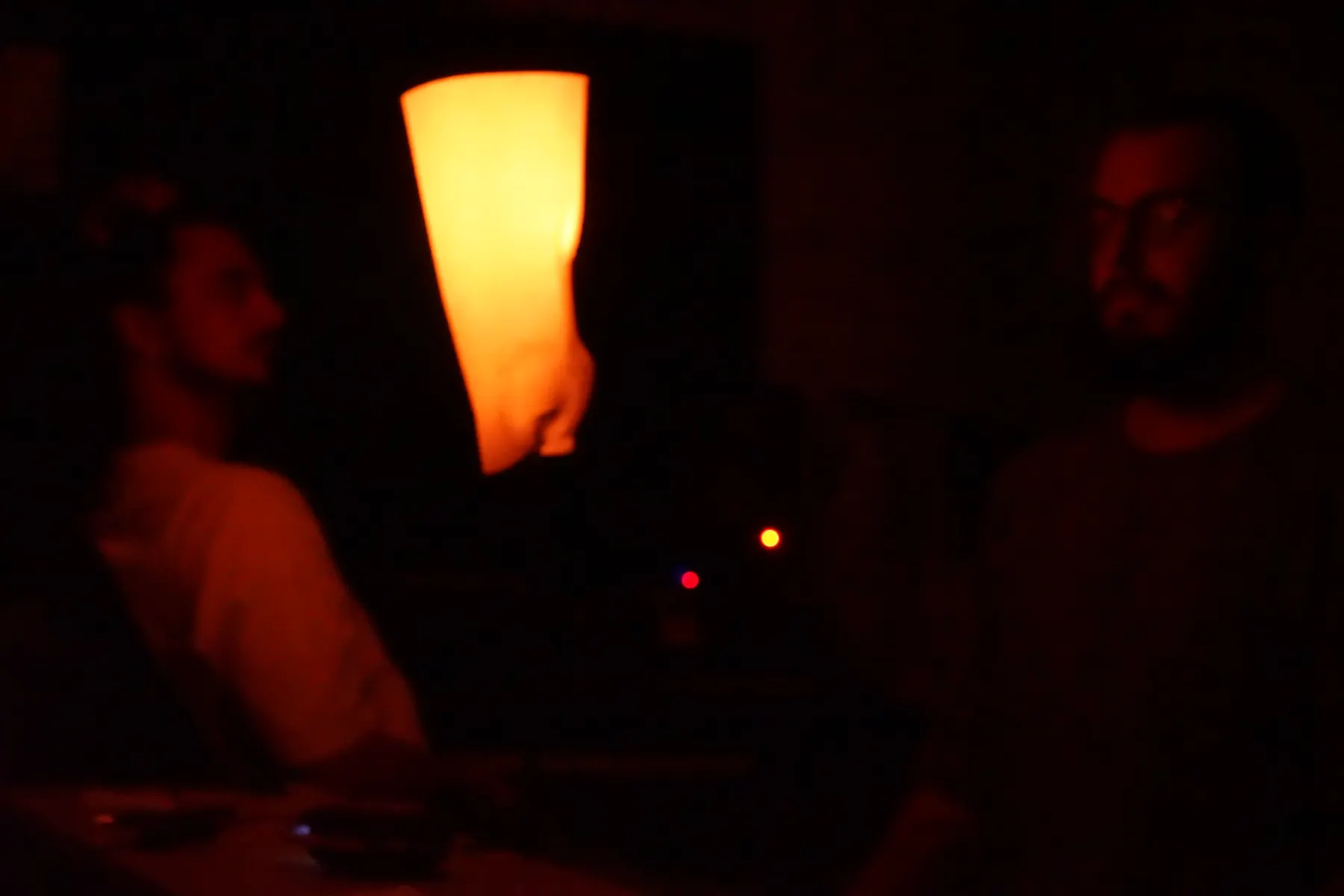
Its placement mattered as much as its animation. Sitting between the players, it became an object in their shared personal space, illuminated their character cards and forced them to look past it to see one another.
Simple systems, coordinated cues
None of these scenes depended on photorealistic simulation. Their impact came from synchronising a few legible signals:
- direction suggested movement;
- colour marked location and danger;
- rhythm gave a source behaviour;
- sound explained what the changing light represented;
- and darkness removed the physical room when it no longer supported the fiction.
The technical scenes established the intended atmosphere, but the players did not always interpret space and movement as we expected. Next: participant feedback and what we learned.